
Will Quantum Export Control Secure The Future Or Shatter It?
Quantum Geopolitics
APR 2, 2026 / BY YLAN TRAN
The opinions, interpretations, and conclusions expressed in this article are solely those of the author(s) and do not necessarily reflect the views of their employers, affiliated institutions, or any organizations with which they are associated. The author(s) bear full responsibility for the content.
But export controls are far from being a modern invention. For centuries, states have restricted the flow of strategic goods and technologies to prevent rivals from copying them, safeguarding their production and innovation as sources of military power and economic dominance.
From Charlemagne’s 8th-century ban on exporting prized Frankish swords3, intended to preserve the superiority of his realm’s metallurgy, to Britain’s later restrictions on exporting textile machinery4, rulers have long treated technology as a strategic asset. By limiting its spread through what we would now call ‘export controls’, they sought to safeguard the industrial advantages that sustained military strength, financed state power, and secured a decisive edge over rival nations.
That said, today’s export control regimes are largely shaped by Cold War non-proliferation efforts and their purpose has also broadened from pure national security goals, sometimes used as strategic leverage to deny rivals access to disruptive technologies, but also as trade negotiation tools or economic sanctions. The ongoing debates over semiconductor export restrictions illustrate this shift that might be detrimental to export controls purpose themselves.
Now, attention is turning to quantum technology, an emerging field that promises extraordinary scientific and economic opportunities, from accelerating drug discovery to simulating complex natural processes with unprecedented precision. At the same time, it carries significant risks: quantum computers could one day break widely used cryptographic systems, enable advanced nuclear simulations, or unlock new materials and chemical processes with clear military implications. In other words, it is a classic dual-use technology.
Which raises the following question: Could quantum technology become a geopolitical weapon, the way semiconductors are today? And if export controls on quantum capabilities begin to take shape, will they succeed in slowing diffusion in a growingly fragmented world, or completely reshape the global landscape of research, industry, and technological leadership in ways we are only beginning to understand?
1. Why modern export control has struggled to deliver results so far?
1/ How the Cold War shaped modern export control
After World War II, the United States wanted to counter the Soviet Union’s nuclear ambitions by pushing for the creation of the CoCom (Coordinating Committee for Multilateral Export Controls), a coalition of non-communist nations and US allies with collective decision-making. CoCom’s mission was straightforward5: curb the spread of nuclear weapons, slow Soviet technological and military development to reduce the risk of global conflict through a unified and multilateral strategy. CoCom became the authority on regulating sensitive exports, maintaining export control lists that covered nuclear materials, international munitions, and industrial goods, including dual-use technologies such as supercomputers and semiconductors.
As computing became increasingly strategic and Cold War tensions escalated, the U.S. imposed strict restrictions on technology exports to the USSR. There is still a debate how much these controls slowed Soviet innovation, alongside internal production and management challenges. Despite the restrictions, the USSR often acquired Western technologies, but as Chris Miller argues6, reverse-engineering them only deepened the lag: Soviet copies were obsolete before they were finished.
Unlike USSR, within CoCom, countries like Japan, South Korea, and Western European allies were considered “friendly” and were allowed access to U.S. semiconductor technologies and know-how. In the 1960s, Japanese firms such as NEC, Toshiba, and Hitachi partnered with US Honeywell and RCA to license U.S. transistor and integrated circuit designs, while state-led initiatives like the VLSI Project (1976–1979)7, one of the biggest state-directed industrial policy successes in history, turned government-orchestrated collaboration into global chipmaking dominance, and wrote the playbook that South Korea and China have been following ever since.
Among the allies, some exceptions are worth pointing out. Indeed, in the 1960s, U.S. export restrictions on certain IBM and Control Data machines for the French atomic energy commission (CEA) prompted the launch of Plan Calcul8, which ultimately failed to create a competitive domestic computer industry.
In short, CoCom played a decisive role in shaping early technology flows, privileging allied nations while limiting access for strategic competitors and forming what would become the future globalised semiconductor supply chain.
2/ From multilateralism to unilateralism
Cocom faced several challenges and became highly inefficient. As private-sector innovation outpaced regulation, export control systems that were built for a world where cutting-edge technology came from defense labs, struggled to keep up. That was especially evident for intangible goods like software, central to national security. Adding to this complexity, dual-use technology occupied a grey zone as they were difficult to restrict militarily without disrupting legitimate trade.
The US pressured Cocom members to follow its lead and scope expansion from end products, which was the primary focus as easier to differentiate military from civilian, to design and manufacturing know-how. The Bucy Report9, a 1976 US DoD task force report on export controls, explicitly argues that technology transfers should be controlled not just because of direct military uses but also because widespread civilian use of technologies like computers would help the Soviet bloc build broader technical capacity (“cultural preparedness”) that could later be exploited for advanced technological development and military applications.
Even after CoCom was replaced by the Wassenaar Arrangement, deemed a multilateral export control framework, the U.S. increasingly used export controls unilaterally, not just for military or dual-use concerns but to slow rivals’ technological progress, especially China. In 2022, Washington restricted advanced semiconductors, AI chips, and manufacturing equipment, a strategy dubbed a “tech Cold War,” and paired these measures with subsidies to reshore semiconductor production. Under the influence of Washington, The Netherlands and Japan joined the U.S. in restricting semiconductor manufacturing equipment10, further limiting China’s access to cutting-edge technology. Yet China accelerated domestic innovation: companies like Huawei developed home-grown chips and an indigenous operating system, producing smartphones that competed strongly with Apple. American sanctions often spurred local alternatives, leading industry leaders like Morris Chang (TMSC founder) to call the effort an “expensive exercise in futility11” due to talent shortages and high costs.
Export controls were designed for a multilateral, consensus-based world, but that world is fading. The U.S. has increasingly acted unilaterally, exposing the limits of frameworks like Wassenaar, where Russian membership alone can paralyze decision-making. Controls have also shifted in purpose, from nuclear nonproliferation to broader economic and technological statecraft, and tend to expand during crises, fueled by domestic politics motivated by a « better safe than sorry »12 logic. But expansion comes with diminishing returns. The wider the controls, the harder they are to enforce and the more allies drift. Worse, restrictions may backfire, scarcity creates incentives, and China has repeatedly responded by accelerating domestic innovation rather than capitulating.
Which raises the central question: given how tightly integrated the global quantum industry is and the growing geopolitical uncertainty, can export controls ever truly be effective?
2. How is quantum export currently regulated?
1/ Quantum Export Control is slowly emerging
Quantum computing is rapidly emerging as a focal point for both public and private investment. As Maud Vinet recently noted, hardware is making a comeback13, as software will become a commodity with AI, hardware is key with quantum poised to follow the internet and GPU booms, now further amplified by AI applications. Quantum represents the next frontier in hardware innovation, with the potential to fundamentally transform computing.
Yet, the technology is still at its infancy. The industry lacks a fully mature supply chain, and critical questions remain unanswered: Will the market consolidate around a few dominant players, or remain heterogeneous? (cf Winner takes all article by Quantum Times)
For a long time, Wassenaar did not explicitly control quantum computing hardware. The 2018 Wassenaar Plenary did agree to add post-quantum cryptography14 to control items, quantum sensing, and also cryogenics but for propulsion-related application rather than the dilution fridge used in some qubit systems. The picture changed substantially in 2022-2023 when several states attempted to add quantum computing controls within Wassenaar, including Spain which proposed controls on computers exceeding 34 qubits15, but those proposals were blocked by Russia, leading to a fragmented approach with national controls on quantum computing through 2024.
The EU Dual-Use list has long served as the mechanism for translating Wassenaar commitments into binding law across member states, updated annually, but quantum computing remained outside it, left to national discretion. The 2024 European Commission White Paper16 pushed for faster, more coordinated controls, backed by the Netherlands and Sweden, though critics argued export controls should remain a national prerogative and warned that securitizing emerging technologies could undermine international R&D collaboration and global quantum supply chains.
In November 202517, the Commission moved to eliminate internal fragmentation by adopting EU-wide controls18 for items blocked at Wassenaar level by Russia, explicitly bringing quantum computers and cryogenic cooling systems under binding rules for the first time.
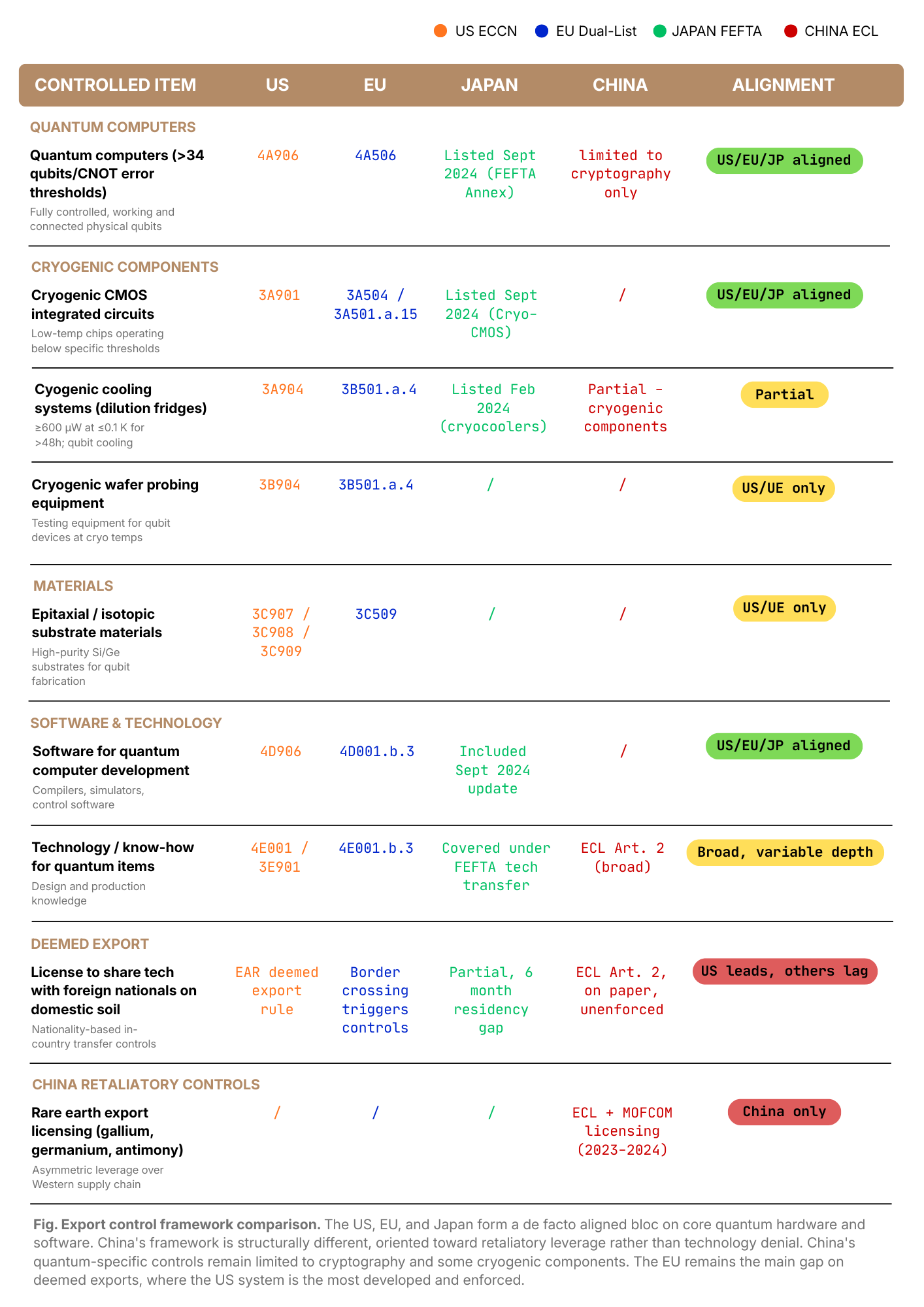
The current export control framework closely mirrors the U.S. Export Control Classification Numbers (ECCNs) developed by the Department of Commerce’s Bureau of Industry and Security (BIS) for quantum technologies19. In septembre 2024, the US BIS published an Interim Final Rule20 issuing new export controls on quantum computing, alongside semiconductor, and other advanced technology.
Japan’s September 2024 update to its FEFTA21 controlled list was notably swift and comprehensive, covering quantum computers, cryo-CMOS circuits, and related software in one move, and doing so in close coordination with Washington, consistent with Japan’s broader posture since 2022, when it joined the US-led semiconductor controls on ASML-equivalent equipment.
2/ What is being controlled and comparison between countries
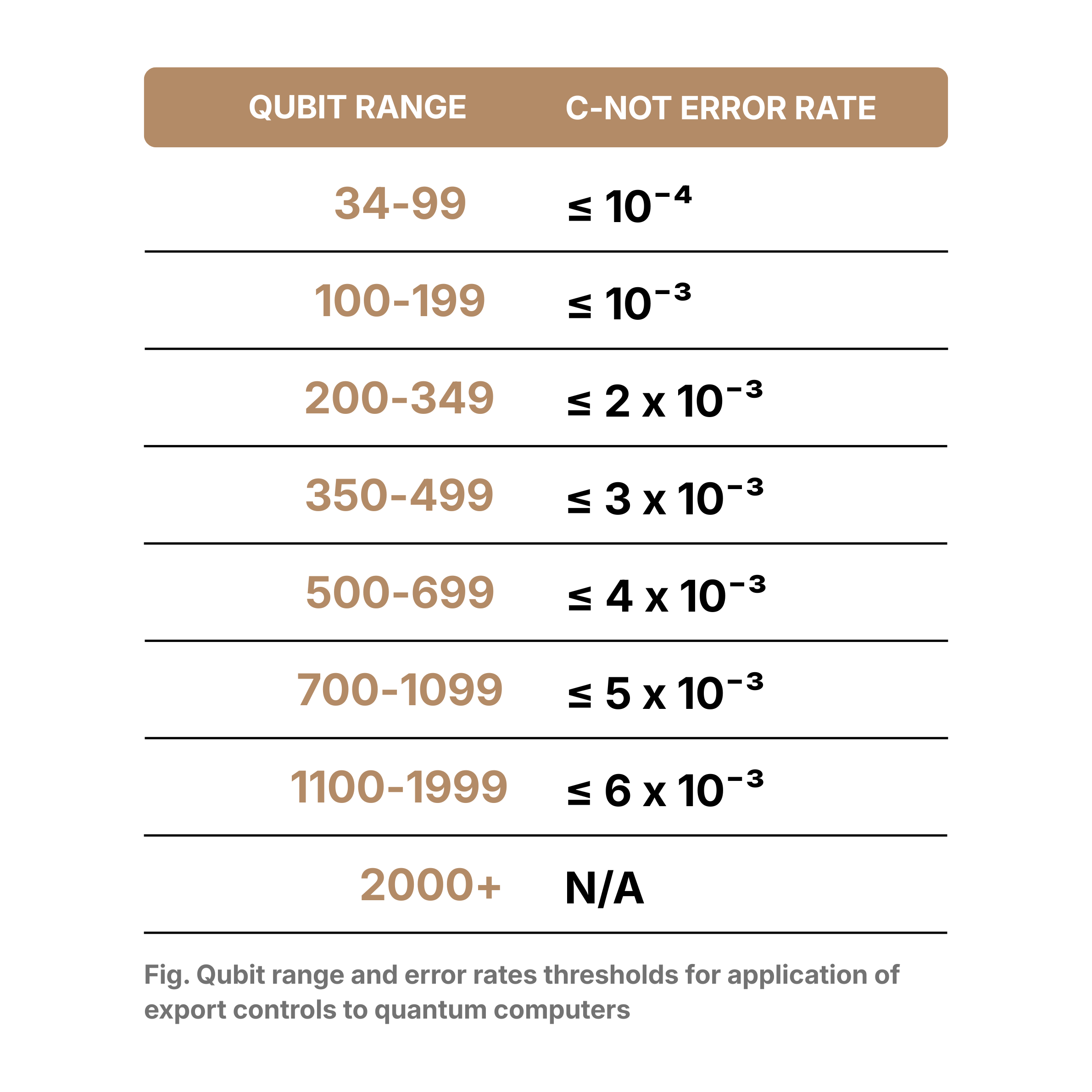
Export controls on quantum computing systems22 apply only to gate-based and measurement-based machines that meet a threshold of two-qubit (CNOT) fidelity, focusing on devices capable of meaningful, scalable computation. This reflects the understanding that systems with many low-quality qubits may perform no better than smaller, high-fidelity machines. Adiabatic and annealing quantum systems are explicitly excluded from these controls.
For software, restrictions target programs specifically designed for the development or production of qubit devices, rather than quantum algorithms themselves. Controls also extend to key enabling technologies, particularly advanced cryogenic cooling systems. Overall, these measures appear aimed less at restricting current capabilities than at shaping the future direction of quantum innovation.
A distinctive feature of the U.S. system is its “deemed export”23 rule, which treats the sharing of controlled technical knowledge with foreign nationals of countries that are not US allies, in the United States, as an export to their home country, potentially requiring a license. This particularity is not present in the EU approach, where export controls are triggered only by the physical movement of tangible goods across borders or when electronic transmission of controlled software from within the EU to a locating outside the EU, or access from third country to an EU-based server, may also be considered a controlled export. The U.S. model creates additional compliance burdens for universities and companies, especially in internationally collaborative fields like quantum research, and has raised concerns about discrimination and reduced attractiveness to foreign talent. Japan has a similar framework but includes a notable loophole: individuals who have resided in the country for more than six months are exempt from deemed export controls, weakening enforcement in practice.
3/ What about China?
China’s Export Control Law (2020)24 resembles Western frameworks on paper but operates on a different logic. Where the US, EU, and Japan use controls to deny technology to adversaries, China’s system is designed primarily to retain leverage25, over its own technology base and as a tool of economic coercion against countries that restrict Chinese firms.
This shows up clearly in what China actually controls. Quantum-specific controls are narrow, covering mainly cryptography, an area where China leads and has strategic reasons to restrict outflows. Its most consequential controls are on raw materials: gallium, germanium, graphite, antimony, and rare earth magnets. These are not nonproliferation tools, they are pressure valves, deployed in response to US chip restrictions and calibrated to maximize pain without severing China’s own export revenues.
China simply does not yet need a Western-style quantum export control regime: it is not yet the leading source of quantum hardware others are trying to acquire. If that changes, particularly in quantum sensing or communications, where China has made real advances, its posture will likely follow.
3. Quantum Control is facing serious challenges but will define the future quantum supply chain
Even though regulations like the EU General Export Authorisations reduces the licensing burden among aligned jurisdictions, implementing export controls on quantum technology however remains highly complex for several reasons.
Technically, the quantum landscape is highly uneven, spanning computing, sensing, and communication technologies. Even within quantum computing, the coexistence of multiple qubit modalities, each with components and technologies advancing at different speeds and impact levels, makes it difficult to create a comprehensive and relevant mapping for export control lists.
Dual-use considerations further complicate this landscape. The blurred boundary between tangible and intangible assets adds another layer of difficulty. For instance, under the Wassenaar Arrangement, defining “dual-use” software, such as intrusion tools, has proven notoriously difficult, as it is often unclear which specific features or components qualify as dual-use. Moreover, quantum computers capable of breaking cryptographic systems or performing advanced nuclear simulations are broadly similar in scale and capability to those enabling major breakthroughs in chemistry and materials science, reinforcing their inherently dual-use nature and complicating regulatory efforts.
Quantum market is still technically evolving. The US 4A906 and EU 4A506 controls trigger at systems exceeding a certain qubit count, broadly around 34 physical qubits, combined with a C-NOT error rate below a specified threshold, roughly in the 10⁻4 to 6×10⁻³ range. The logic was to capture systems powerful enough to pose a cryptographic or computational threat while excluding research-grade hardware. The problem is that the frontier has already moved well past these thresholds. Best-in-class systems from IBM, Google, and IonQ now operate with hundreds to thousands of physical qubits, and leading two-qubit error rates are pushing toward 10⁻⁴, an order of magnitude better than what the controls were calibrated against. In other words, the controlled item is no longer the cutting edge; it is mid-range hardware. However, the systems that actually matter for breaking encryption or accelerating drug discovery or materials simulation are fault-tolerant machines requiring error rates of 10⁻¹⁰ to 10⁻¹⁵. No current hardware comes close. Export controls set today at 10⁻³ may be controlling the wrong layer of the stack entirely, hardware that is interesting but not yet strategically decisive. Worse, qubit count and raw C-NOT might just be the wrong variables and might not control the IP where is really is. Unilateral export controls on frontier technologies also appear ineffective, a point made by Eric Hirschhorn, former head of BIS, who compared it to “damning half the river”26
Quantum market is still an evolving international ecosystem with moving supply chain. Quantum computing industrial collaboration and talent network is still widely international. Governments must strike a careful balance between protecting critical intellectual property and attracting international talent, while ensuring that private companies can still find markets and commercialise their innovations. Premature or overly restrictive export controls risk disrupting international research collaboration, slowing innovation, and undermining a country’s competitive advantage. They could also reduce visibility over rivals’ technological progress, create uncertainty in supply chains, and limit commercial opportunities. Additionally, the physical and centralized nature of quantum systems, currently confined to laboratories and institutional settings, makes licensing, inspection, and compliance more feasible, even though miniaturization and remote access are foreseeable future trends.
Geopolitical uncertainty further complicates export control efforts. Washington’s willingness to act unilaterally on semiconductor controls, pressuring allies bilaterally rather than building genuine multilateral consensus, sets a worrying precedent for quantum. The current alignment with Japan and the EU was achieved relatively smoothly, partly because quantum hardware is still early-stage and economic stakes remain modest. But if Washington moves to tighten qubit thresholds, extend cryogenic controls, or harden deemed export rules without allied buy-in, the coalition could fracture. European quantum firms, Pasqal and IQM are growing commercially, and European governments are unlikely to harmonize with a US regime that threatens their own industrial champions or chills academic collaboration. In a technology where breakthroughs are still happening in university labs and small startups spread across allied nations, unilateral US action without genuine coalition-building may protect very little while fragmenting a lot.
Conclusion
Quantum export controls are a double-edged sword. Too broad, and they fragment research and slow innovation. Too narrow, and they leave strategic vulnerabilities exposed. The satellite industry offers a cautionary tale: US controls introduced by the 1999 NDAA inadvertently handed market share to European competitors, collapsing the US share of the global commercial satellite market from 73% to 25% in a decade. Quantum risks the same dynamic, pushing restricted parties to accelerate domestic programs and fragmenting the ecosystem into parallel supply chains. It’s also worth noting the parallel emergence of inbound investment screening regimes covering quantum. The UK’s National Security and Investment Act has been using it to impose conditions on US-backed quantum deals, and the EU has revised its FDI (Foreign Direct Investment) Screening Regulation and will mandate that all Member States screen investments in quantum technologies, showing the growing securitisation of the sector.
As M. Karanicolas and A. Zornetta argue in Just Security27, a “quantum divide” is forming, concentrating advanced capabilities in wealthy nations while leaving much of the Global South on the outside looking in. Without careful, coalition-based coordination, quantum could turn into a playground for the few, leaving the rest scrambling for scraps. Solving this dilemma of balancing security with an open scientific environment, will take surgical precision, not a blunt unilateral hammer.

Ylan Tran is an investor at Quantonation. Previously she had business and strategy roles at Quandela and Alice&Bob.
References
1D. Shepardon, K. Freifeld, « China’s Huawei, 70 affiliates placed on U.S. trade blacklist », May 2019, (https://www.reuters.com/article/business/chinas-huawei-70-affiliates-placed-on-us-trade-blacklist-idUSKCN1SL2W4/)
2MA. Kharpal, E. Cheng, « Nvidia CEO Jensen Huang wants to sell more advanced chips to China after H20 ban is lifted », Jul. 2025, (https://www.cnbc.com/2025/07/16/nvidia-ceo-wants-to-sell-advanced-chips-to-china-after-h20-ban-lifted.html)
3https://www.medievalware.com/blog/a-brief-history-of-the-sword/
4https://en.wikipedia.org/wiki/Textile_manufacture_during_the_British_Industrial_Revolution
5C. Leslie, « From CoCom to Dot-Com: Technological Determinisms in Computing Blockades, 1949 to 1994 », Nov 2019, (https://inria.hal.science/hal-02386549/document)
6C. Miller, « The Struggle to Save the Soviet Economy: Mikhail Gorbachev and the Collapse of the USSR », 2016
7https://museum.ipsj.or.jp/en/computer/main/history.html
8https://fr.wikipedia.org/wiki/Plan_Calcul
9US. Department of Defense, « An Analysis Of Export Control Of US Technology, A DoD Perspective », Feb 1976, (https://apps.dtic.mil/sti/tr/pdf/ADA022029.pdf)
10« Japan, Netherlands to join US in restricting chip equipment exports to China, Bloomberg reports », Reuters, Jan 2023, (https://www.reuters.com/technology/japan-netherlands-join-us-china-chip-controls-bloomberg-2023-01-27/)
11P.S. Goodman, « 18,000 Reasons It’s So Hard to Build a Chip Factory in America », Dec 2025, (https://www.nytimes.com/2025/12/04/business/tsmc-phoenix-fab.html)
12J. Lind, « Cold War Lessons for Export Controls Against China », Fall 2025, (https://tnsr.org/2025/11/cold-war-lessons-for-export-controls-against-china/
14Implementation of Certain New Controls on Emerging Technologies Agreed at Wassenaar Arrangement 2018 PLenary, (https://www.federalregister.gov/documents/2019/05/23/2019-10778/implementation-of-certain-new-controls-on-emerging-technologies-agreed-at-wassenaar-arrangement-2018)
15S. Grimm, « Mysterious quantum computing restrictions spread across multiple nations, UK cities national security risks and reguses to elaborate », Jul. 2024, (https://www.tomshardware.com/tech-industry/quantum-computing/mysterious-quantum-computing-restrictions-spread-across-multiple-nations-uk-cites-national-security-risks-and-refuses-to-elaborate)
16White paper on Export Controls, European Commission, Jan. 2024, (https://eur-lex.europa.eu/legal-content/EN/TXT/PDF/?uri=CELEX:52024DC0025)
17/182025 Update of the EU Control List of Dual-Use Items, European Commission, Sept 2025, (https://policy.trade.ec.europa.eu/news/2025-update-eu-control-list-dual-use-items-2025-09-08_en)
19BIS Adopts Additional Controls on Quantum, semiconductor and additive manufacturing technologies in concert with international partners, Mayer/Brown, Sept 2024, (https://www.mayerbrown.com/en/insights/publications/2024/09/us-commerce-implements-export-controls-on-advanced-technology-in-concert-with-international-partners)
20Interim Final Rule, Nov. 2024.
21T. Hasegawa, « Japan updates Listed Controlled Items to include sensitive items such as quantum computers », Oct. 2024, (https://sanctionsnews.bakermckenzie.com/japan-updates-listed-controlled-items-to-include-sensitive-items-such-as-quantum-computers/)
22https://www.legislation.gov.uk/uksi/2025/1197/regulation/10/made/data.xht?view=snippet&wrap=true
23Guidelines for Preparing Export License Applications Involving Foreign Persons (Deemed Exports/Reexports), Sept. 2024, (https://www.bis.gov/sites/default/files/documents/deemed-exports-licensing-guidelines-foreign-persons.pdf)
24« China’s export control law, what it will mean for exporters », KPMG, (https://kpmg.com/kpmg-us/content/dam/kpmg/pdf/2020/china-export-control-law.pdf)
25X. Jiaying, « China’s Post-2018 Economic Statecraft: Sanctions, Countersanctions, and Export Controls », The Diplomat, Sept. 2025, (https://thediplomat.com/2025/09/chinas-post-2018-economic-statecraft-sanctions-countersanctions-and-export-controls/)
26L. Ottinger, « The Cold War History Of Export Controls », ChinaTalk, May 2025, (https://www.chinatalk.media/p/learning-from-cocom#_)
27M. Karanicolas, A. Zornetta, « The Digital Divide Meets the Quantum Divide », May 2025, (https://www.justsecurity.org/111035/digital-divide-meets-quantum-divide/)