
MIND SNACKS
#1 Quantum Computing Still Needs its “AlexNet moment”.
March 26, 2026 / BY VICTOR KERROS
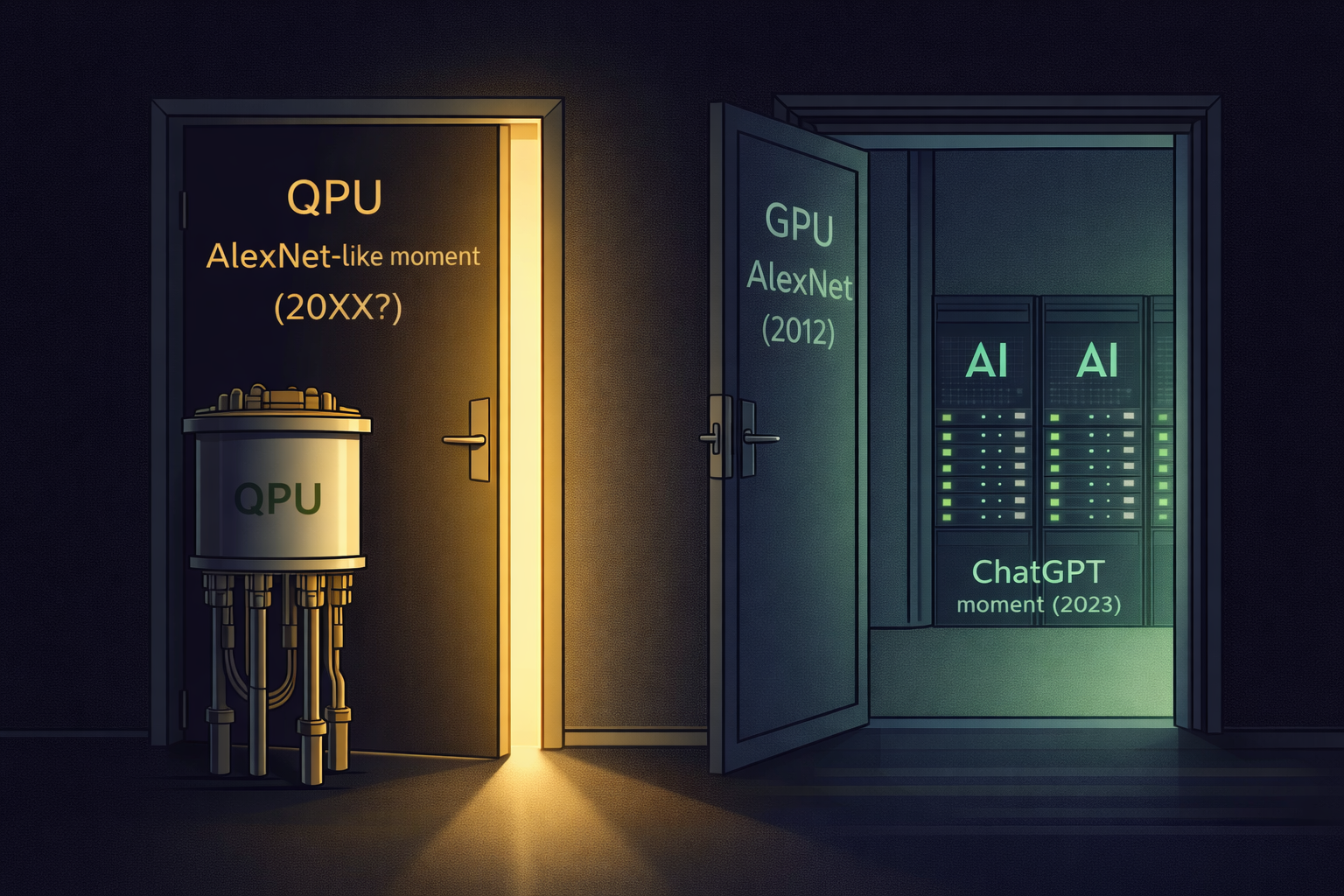
Software revolutions begin in hardware, typically 5-10 years before they become visible for most end users.
Quantum computing promises a significant change in computational power. It could reshape industries, from chemistry to logistics. But today, that promise remains unrealized. Early demonstrations of “quantum advantage” exist, yet they are limited to useless or niche scientific problems.
The key milestone to watch is simple: the “AlexNet moment” of quantum computing.
Those who spot it early, across governments, investors, and corporate end-users, will capture most of the benefits.
Here is the pattern to follow:
Phase 1: HPC Validation
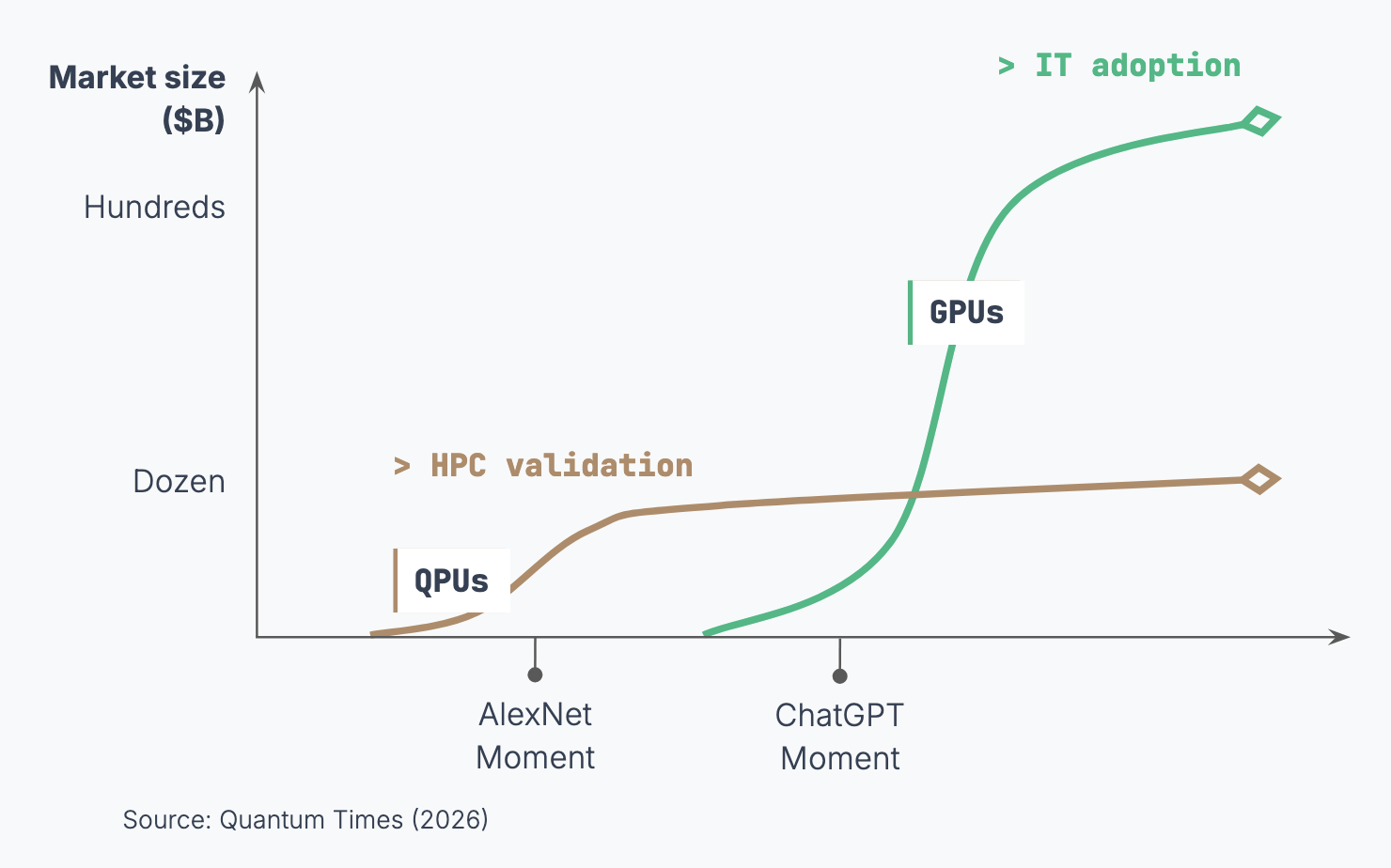
Before AI exploded, GPUs were gradually adopted in high-performance computing (HPC). Originally developed for gaming, Nvidia GPUs were quickly used for scientific workloads such as physics and chemistry simulations. By 2010, 10% of top supercomputers already used GPUs.
Quantum processors (QPUs) are at this stage today: early deployments in HPC centers, validating performance on scientific computing workloads.
Phase 2: the “AlexNet moment”
In 2012, the AlexNet deep-learning model, trained on Nvidia GPUs, clearly outperformed CPUs in the ImageNet competition (40% less errors). It was a a clear demonstration of significant performance advantage on a problem with strong industrial relevance (autonomous vehicles, medical image analysis, industrial quality control, etc).
From that moment, the market expanded beyond HPC (~$20B) to the much larger enterprise automation opportunity (~$100B+), supported by the larger trillion-dollar IT market. AlexNet eventually led to ChatGPT-like moments, that revolutionize entire industries.
An investor who had bought Nvidia stock around that time would have achieved roughly a 600× return (vs. 50× for investors after the 2017 “Attention Is All You Need” paper from Google).
What to Watch for in Quantum
Possible “AlexNet moment” candidate applications for quantum computing include:
- Unprecedented accurate molecular and materials modeling which could cascade into transformative impacts across chemistry, materials, and drug discovery, sparking a huge demand for quantum computers from the industry.
- New algorithms or heuristics emerging as quantum hardware matures could unlock value in optimization or AI-related workloads, by performing beyond the capabilities of classical computers or by being more cost-efficient.
#2 Shor's Algorithm is Quantum’s Pharmakon
April 16, 2026 / BY VICTOR KERROS
Shor’s algorithm has been a powerful narrative to trigger public investments and, as such, a key driver of quantum technologies progress, but it may now begin to slow the field down.
Shor’s Algorithm as a Catalyst
At first, Shor’s algorithm acted as a catalyst. Discovered by Peter Shor in the 1990s, it showed that a quantum computer, if powerful enough, could break RSA and cryptocurrencies (ECC) encryption. Suddenly, quantum computing was no longer just a tool for exploring science (Feynman’s initial vision). It became a direct threat to the digital economy built on classical cryptography.
Governments took notice and started investing heavily to avoid lagging behind on this strategic infrastructure.
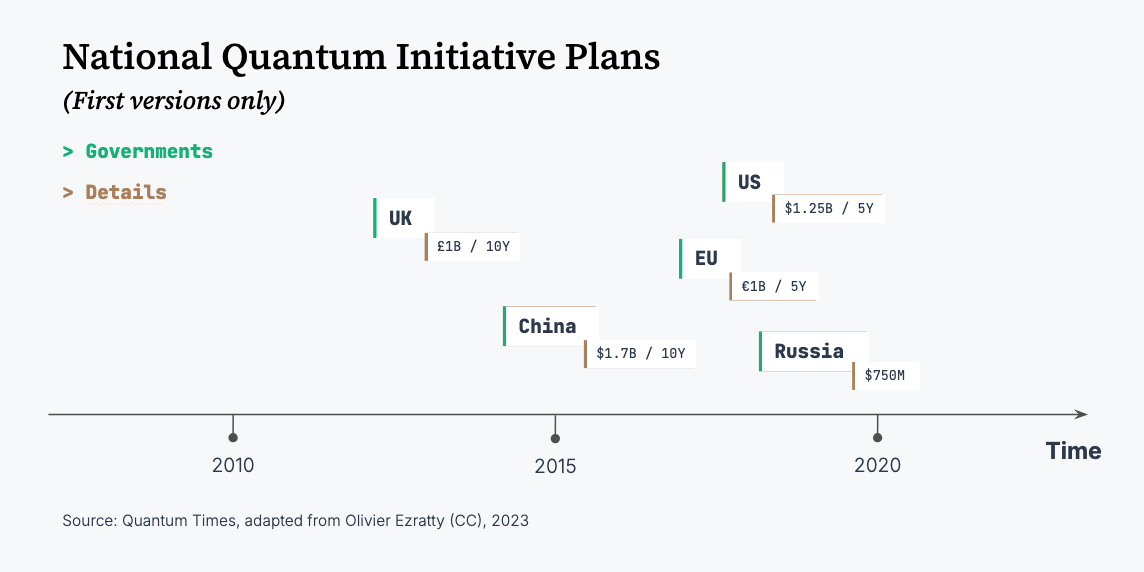
These programs funded hardware and algorithms development, academic labs and start-ups. They helped structure the field and gave it long-term direction, which is key for deep tech. In that sense, Shor was a booster drug.
The Same Force May Now Slow Things Down
Building a full quantum computing system is too complex for any single lab or company. Progress relies on open research and collaboration, as Austin Fowler recently emphasized. But as Shor’s implementation becomes more realistic, that openness may start to shrink.
Indeed, recent progress has cut the resources needed to break cryptosystems like RSA and ECC by around 100x. What once looked decades away, requiring millions of qubits, now appears in some 2030-2033 roadmaps. The threat is starting to feel real for governments.
And when a technology becomes a real security concern, openness tends to fade. As Scott Aaronson pointed out, the Manhattan Project followed that path: research on uranium fission was published, until it wasn’t.
We may already be seeing early signs with quantum computing. First, Google recently chose not to openly release its latest quantum algorithm for breaking cryptosystems. Critically, access to advanced fabrication could become limited under geopolitical pressure.
It’s a shame as quantum computing could benefit other areas, for the greater good. The cure may lie in post-quantum cryptography – more on this soon.
#3 Quantum is Breaking the "National Security" Frame
May 11, 2026 / BY YLAN TRAN
Governments are starting to treat quantum the way they treat semiconductors (and now AI): screening foreign investments, blocking acquisitions, protecting supply chains. The US has CFIUS, the EU has its FDI Screening Regulation, the UK has the NSI Act, Japan has FEFTA. The logic is familiar: don’t let adversaries gain access to strategically important technology.
But I’m not sure that framework actually fits quantum.
The real danger may not be that China gets a Cryptographically Relevant Quantum Computer before the US does. It may be that anyone gets one before Post-Quantum Cryptography is fully deployed. In that sense, the risk is fundamentally symmetric: once the capability exists, everyone becomes exposed at the same time.
That makes quantum feel less like a weapon and more like a shared vulnerability.
Nuclear technology was probably the first case where a purely national security framework became insufficient as no state could protect itself from nuclear risk unilaterally. The best the world could do was manage a shared exposure through institutions like the IAEA, the NPT, and eventually mutually assured destruction (MAD) as a kind of stabiliser.
Quantum has a similar structure, but very different dynamics.
Nuclear had Trinity: a visible, undeniable detonation. Quantum’s equivalent would be Shor’s algorithm silently breaking RSA with no explosion, no signal, and no attribution. And if you can’t detect it, you can’t verify it. If you can’t verify it, it becomes incredibly difficult to build treaties or enforcement mechanisms around it. There’s no MAD logic here to stabilise behaviour.
In some ways, it feels closer to Enigma. But even that analogy falls short as Enigma targeted one adversary’s cipher system, when quantum threatens the mathematical assumption underlying almost all modern secure communication at once.
So maybe the point of FDI screening in quantum, Quantum Export Control, etc. aren’t really to “protect” the technology itself from non-allied countries. But maybe it’s about buying time, preserving temporary asymmetries long enough for PQC to become universal.
Countries have failed to act collectively on the shared negative externality of climate change, partly because the nations affected first and most severely are those in the Global South. Quantum technologies, meanwhile, are poised to unlock major scientific breakthroughs while also creating entirely new challenges for international security. In this context, perhaps quantum geopolitics should be understood less as defending national positions on a chessboard, and more as the need for institutional innovation and the management of a countdown that ultimately traps us all together.
The real question may not be whether quantum will force some kind of institutional innovation, the way nuclear technology did. It almost certainly will. The question is whether we build those institutions before the quantum’s Trinity moment, or only after it.
#4 How Tech Giants Face Quantum’s Innovator’s Dilemma
June 30, 2026 / BY VICTOR KERROS
Tech giants – Nvidia + GAFAM – and quantum computing are entangled in a very specific way. Their current success is deeply tied to the classical computing stack that quantum could one day disrupt: cloud, datacenter infrastructure, cybersecurity, and enterprise software. In that sense, they are facing the innovator’s dilemma. But we’ll see that they are powerful enough – with trillion dollar valuations – to fund the ecosystem and position themselves.
The attraction is obvious: if useful quantum computers emerge, they could become the added-value driver of a next-generation compute infrastructure, with application potential across scientific discovery, engineering simulation, and perhaps even optimization and AI training. At the same time, much of that potential remains unknown – that uncertainty being part of what makes the field so strategically exciting.
We identify three levels of response:
1/ Build: Google, Microsoft, and Amazon have all invested heavily in internal quantum hardware R&D, but with very different approaches. Google built much of its quantum identity around transmon superconducting qubits, one of the most mature routes, while recently expanding into neutral atoms. Microsoft has made a more radical long-term bet on topological qubit. Amazon combines the mature superconducting qubit development with a newer qubit type, the cat qubits.
2/ Hedge: quantum hardware development remains too early for an all-in bet, though the field exhibits a long-term winner-takes-all structure. This explains the growing role of partnerships, and corporate venture capital for tech giants, i.e. a seat at the table if the winning platform emerges outside their own labs. Microsoft’s partnerships with Quantinuum or Atom Computing gives it exposure to trapped ions or neutral atoms while maintaining its internal topological qubit roadmap. Google participated in the latest funding round of QuEra, a leading neutral atom player. But the canonical example is Nvidia, which is not developing the quantum hardware but multiplies partnerships with the whole quantum ecosystem and has been investing in four companies, each developing a different qubit modality.
3/ Control: AWS Braket, Azure Quantum, and Google Cloud are a way for hyperscalers to foster a community of developers, researchers, and enterprise users around their cloud platforms. By giving access to early quantum machines, they position themselves to control the access layer to useful quantum computers when the market matures. For instance, QuEra recently announced that their first useful computers will be made accessible on AWS Braket. Nvidia, though not offering cloud services, also develops the quantum software stack with CUDA-Q to bring the power of their GPUs closer to the QPUs.
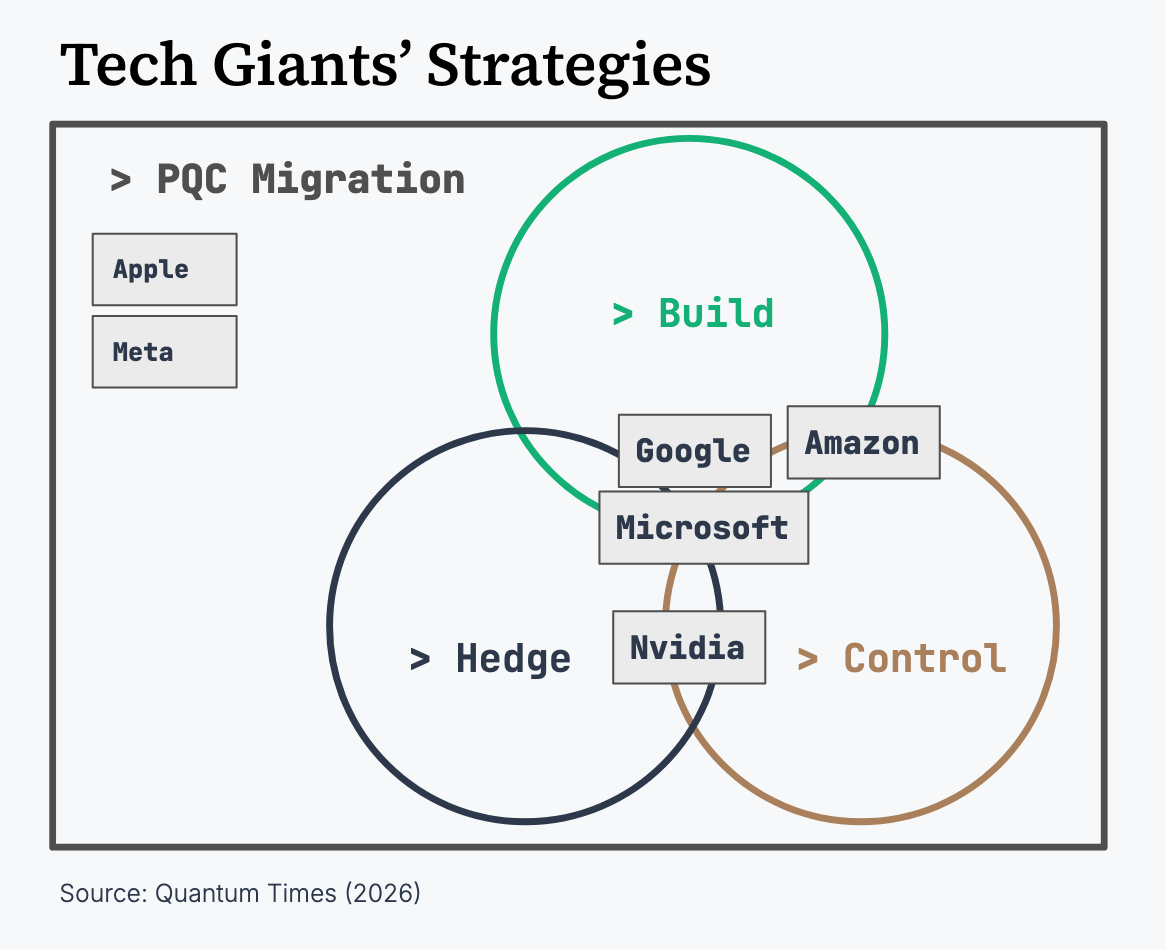
Finally, all major tech giants are migrating their classical compute infrastructure to post-quantum cryptography (PQC). The goal is to protect their existing digital businesses from future quantum attacks. For instance, Apple and Meta – though they are not in the business of selling compute time, such that they are less directly exposed to a new quantum infrastructure player – have already been implementing the newly standardized PQC protocol.