
Will Quantum Computing Ever Become a Consumer Technology?
Quantum Markets
JUL 22, 2026 / BY VICTOR KERROS
The opinions, interpretations, and conclusions expressed in this article are solely those of the author(s) and do not necessarily reflect the views of their employers, affiliated institutions, or any organizations with which they are associated. The author(s) bear full responsibility for the content.
Quantum computing may eventually reach consumers but that would be long before quantum computers reach their homes.
In 2025, the Consumer Electronics Show (CES) hosted a half-day programming track on quantum technologies for the first time. Is this a sign that quantum computing is breaking into the consumer market?
No – though quantum computers already exist and can even be accessed remotely through the cloud, they are not yet part of a consumer market. Only a few hundred systems appear to have been deployed worldwide, practical applications remain limited, and the machines still require expensive, highly specialized infrastructure.
That said, the history of classical computing suggests that this possibility should not be dismissed too quickly. Computers were once room-sized machines available only to governments, universities, and large companies. They became mass-market products through a reinforcing flywheel: miniaturization and falling costs broadened access, larger user and developer communities created new applications, and growing demand justified further investment in performance, manufacturing, and system integration, driving another cycle of lower costs and wider adoption, and so on.
This article examines how quantum computing could first reach consumers, and whether the first signs of a similar computing consumerization flywheel are already visible.
1. The “quantum PC” is a distant dream
The quantum chip may be small but the machine is not
The familiar image of a quantum computer – a small chip hidden inside a chandelier of cables and cryogenic equipment with several racks of classical computers next to it – captures the main obstacle to consumer quantum hardware. IBM’s Quantum System Two is 22 feet wide – this does not fit into everyone’s living room. This is why Microsoft’s claim that a future million-qubit processor could fit in the palm of a hand should be treated carefully: the chip may be small, but it would still need to operate inside a much larger cryogenic and classical system.
Beside the form factor, cost represents an equally important barrier to consumer market adoption. Public procurement contracts suggest that quantum systems currently cost several million dollars, and larger installations can reach tens of millions.
Some qubit modalities like neutral atom or trapped ions limit the use of cryogenics but still have a significant form factor and cost due to precision lasers, ultra-high vacuum chambers, or vibration isolation casing.
A specialized accelerator, not a general-purpose computer
Even if quantum machines became dramatically smaller and cheaper, most people would still have little reason to own one. In the foreseable future, quantum computers will remain specialized accelerators for scientific and engineering applications.
Neil Thompson from MIT describes the competition as a race between a “classical hare” and a “quantum tortoise”. Classical processors execute everyday operations very fast and can handle large amounts of data, while quantum computers catch up only when it needs significantly less operations for some very complex applications that do not require a lot of data (e.g. simulating a material, a drug). They are therefore poorly suited to the everyday work of consumer computing devices, such as storing files, spreadsheets, displaying video or making AI inference. Furthermore, quantum advantage would not necessarily make these computations fast. Useful applications may still require very long circuits and run for hours or days. A quantum calculation could outperform the best classical alternative and still be far too slow for an interactive consumer service. For instance, LLMs are often presented as a potential quantum application, but Olivier Ezratty argues that current quantum resource estimates point to prohibitive data-loading and circuit-execution times.
That makes consumer-facing applications of quantum computing improbable over the next few years. But it does not rule out consumer-impact.
In the foreseeable future consumers will encounter quantum-powered services or products
In the next decade, quantum computers will likely remain back-end infrastructure inside materials research laboratories, pharmaceutical companies, financial institutions, and cloud or HPC data centers. Consumers may nevertheless benefit from their outputs – for example through a better medicine, batteries or potentially financial service – without ever interacting with the machine.
This would not be unprecedented: classical computers initially reached consumers indirectly through services long before anyone owned a computer at home. For instance, in the 1960s IBM and American Airlines’ SABRE system powered real-time airline reservations. AI offers a more recent parallel. Consumers don’t own the GPUs and TPUs used and run advanced language models, yet they rely on that compute infrastructure every day. Quantum computing could follow a similar cloud model, with applications calling remote quantum computers for the parts of a workflow where they provide an advantage.
2. Toward the quantum computing consumer market flywheel
In the 1950s, machines such as the UNIVAC I occupied an entire room, weighed several tons, and sold for more than $1 million. Computing was also concentrated in governments, research institutions, and large companies, with applications ranging from scientific calculations to defense and administrative data processing. Now,
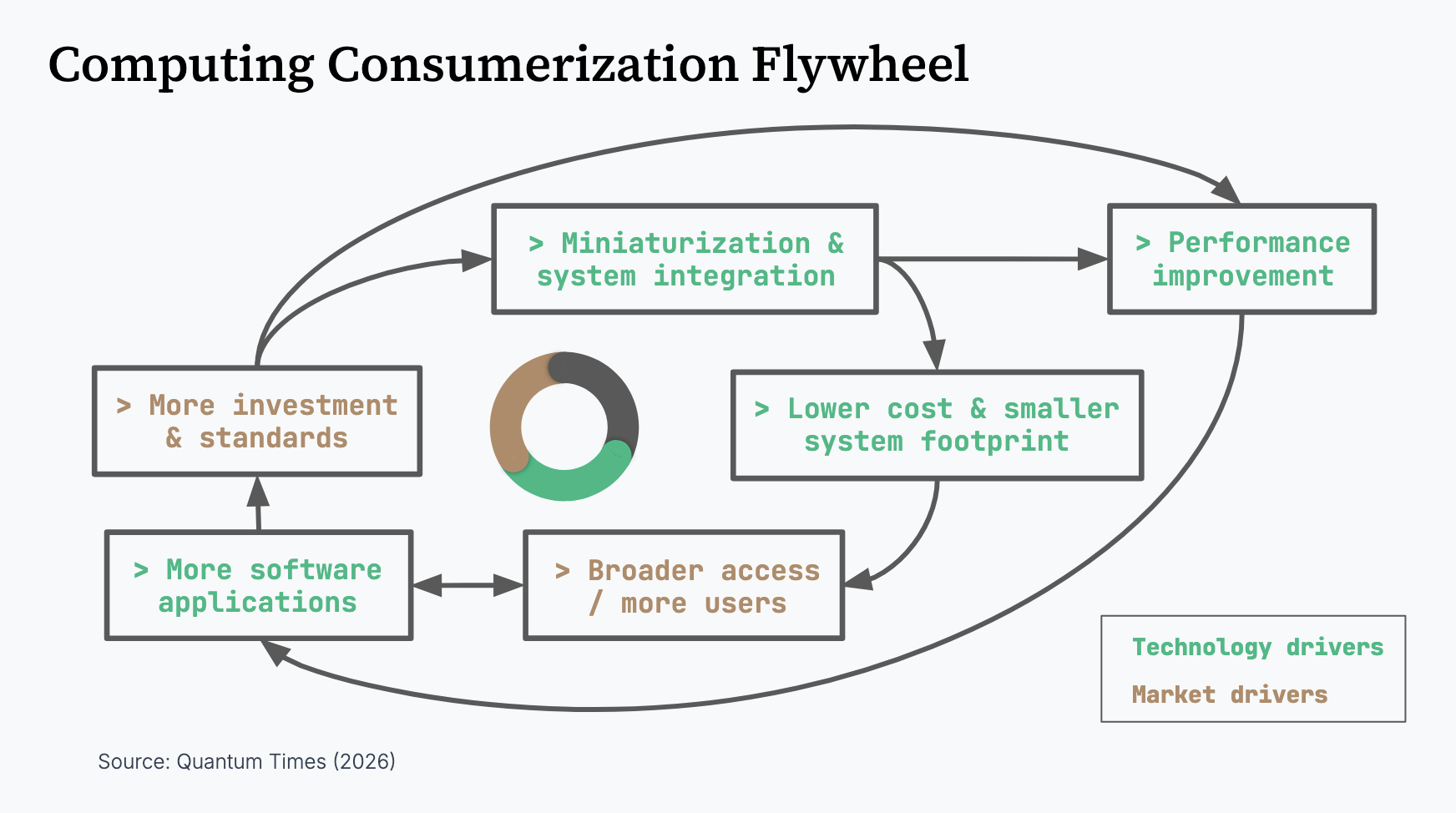
Yet the consumer computer did not emerge simply because engineers kept improving these machines. It resulted from a flywheel that can be summarized as follow:
Miniaturization and system integration reduce cost and footprint, broadening access. More users, combined with improving performance, create new applications. Those applications attract investment and support common standards, which fund further improvements in integration, manufacturing, and performance.
Richard Feynman anticipated part of this dynamic in his 1959 speech There’s Plenty of Room at the Bottom. He argued that computers could become way smaller and that increasing the number of components could give them entirely new capabilities (“if [computers] had millions of times as many elements, they could make judgments”). Six years later, Gordon Moore predicted that integrated circuits would pack rapidly growing numbers of components at a declining cost per function, eventually opening the way to home computers and other consumer electronics.
Quantum computing has not yet activated such a flywheel. But some of its drivers could begin to set it in motion.
1/ Applications and software environment will foster demand
Better hardware does not create a mass market on its own. Users need applications compelling enough to justify buying – or at least accessing – the machine.
Classical computing went through several such moments. In the 1960s, Spacewar! showed that computers could enable entertainment, although only the small number of people with access to a PDP-1 – the mainframe computer that ran the game – could play it. Toward the end of the 1970s, VisiCalc from Apple became one of the first applications that convinced customers to purchase a personal computer. More recently, the AlexNet model (2012) demonstrated that GPU-based deep-learning could be efficiently scaled for image classification tasks, a clear consumer applications which launched a large demand for AI.
Quantum computing is still waiting for its consumer moment. Scientific simulation may produce the first economically useful workloads, but a broader consumer impact through the cloud would probably require applications in fields such as AI or optimization. Whether quantum computers can deliver a sufficiently large advantage in these areas remains however uncertain, though we should be optimistic when it comes to the potential for heuristic development (as this also happened with classical computing). For instance, Peter Shor takes the example of the Simplex algorithm that had exponential compute scaling in the worst case but turned out to be very performant in practice.
Whilst waiting for more performant quantum computers to test ideas and develop new application, the software infrastructure for remote access already exists, building on decades of classical computing history. As early as 2016, IBM made a five-qubit processor available through the cloud, allowing anyone with an internet connection to run a quantum circuit without owning the machine. But access to hardware is different from accessibility. Programming quantum computers today still requires developers to work relatively close to the circuit and hardware level. Services such as Qiskit Functions are beginning to hide hardware execution behind higher-level interfaces. The historical parallel could be BASIC, which helped – as early as 1964 – expand classical computing beyond specialists by allowing students to program using a much simpler language. Quantum computing will need many more layers of abstraction before application domain experts can use it without also becoming experts in quantum physics.
In parallel, algorithm improvements already reduce the hardware required for an application. A 2019 estimate suggested that factoring an RSA-2048 number would require around 20 million noisy qubits. In 2025, improved algorithm and quantum computing architecture reduced this estimate to fewer than one million. A 2026 preprint proposed a neutral-atom architecture that could run cryptographically relevant versions of Shor’s algorithm with tens of thousands of physical qubits, although under different assumptions and with much longer run times. These estimates are not directly comparable, but they show that algorithmic and architectural progress can effectively shrink the machine before the hardware itself becomes smaller.
2/ Performance has to become economic
Algorithmic quantum advantage alone will not be enough. A quantum computer must produce a useful result faster or more cheaply than the best classical alternative once the entire workflow is considered. This is the idea behind MIT’s Quantum Economic Advantage Calculator which compares quantum and classical systems using factors such as hardware costs, gate speed, and the comparative algorithmic performance.
However, many quantum computing components remain specialized, produced in low volumes, and difficult to integrate. For instance, a large dilution refrigerator alone can cost more than €1 million. Therefore, cost will need to fall at the same time as performance improves. Classical computing benefited from standardized manufacturing, large production volumes, and a semiconductor supply chain able to produce increasingly complex chips at a declining cost per function. Quantum computing still has to reach comparable industrial scale.
Energy could create another ceiling, according to Olivier Ezratty. Depending on the modality and architecture, a utility-scale quantum computer may require several MW of power for cryogenics, control electronics, and classical error decoding. Quantum computers do not need to consume less energy than a laptop, but a machine requiring the energy infrastructure of a supercomputer will remain forever a data-center technology rather than a consumer-owned device.
3/ Miniaturization is not the priority
Miniaturization was the engine behind classical computing consumerization. Integrated circuits invented in the 1960s improved reliability while reducing size and cost. The price of a transistor eventually became so low – from 1 dollar in 1968 to below 10^-5 USD in the late 1990s – that computing could be embedded in cars, electronic appliances, phones, and almost every other consumer product. Now, a petaflop (= one quadrillion of operations per second) fits on a desk whilst the room-sized ENIAC had a sub-kiloflop performance. This is a 12 orders of magnitude improvement in 70 years.
However, quantum computing faces a more difficult integration problem. As explained in the first part, shrinking the qubit size is only one part of shrinking the machine. For instance, even with ultrathin materials, or better qubit designs, superconducting qubits still require cryogenics and complex wiring components that do not necessarily scale at the same rate as the chip. Similarly, neutral-atom and trapped-ion systems still need many lasers, costly optical systems, and vacuum chambers.
Instead, a system-level integration is required to unlock miniaturization. Bluefors has developed a compact dilution refrigerator that integrates the cryostat, gas-handling system, and electronics rack into a smaller unit that could fit in a small room. Though it’s not yet as small as a kitchen fridge, it looks like we’re getting there. Also, to reduce the need for control electronics racks, IBM has demonstrated cryogenic CMOS control chips. Semiconductor spin qubits may offer another path because of their small footprint and partial compatibility with established CMOS manufacturing.
Other modalities have their own miniaturization opportunities. For instance, optical metasurfaces may replace complex arrangements of optical equipment in neutral-atom systems. These early innovations would not produce a personal quantum computer by themselves, but they could begin to compress the surrounding infrastructure.
Note that desktop quantum computers based on Nuclear Magnetic Resonance (NMR) technology already exist though their computations can be reproduced easily with an ordinary – and cheaper – classical computer. SpinQ, a Chinese company, for example, sells room-temperature NMR systems with between two and 13 qubits for approximately $5,000 to $50,000. These machines are closer to scientific demonstration kits for education than to the first generation of useful quantum PCs.
Closing thoughts and future works
The consumerization wheel could start flying for quantum. Quantum computing does not yet have a VisiCalc or even a Spacewar! moment. Its machines remain too expensive and difficult to operate, and its useful applications remain too narrow. But cloud access, expanding developer communities, falling resource estimates, and early progress in system integration represent the first ingredients. The consumer market would emerge only if these separate advances begin to reinforce one another.
In 1960, J. C. R. Licklider imagined networks of shared “thinking centers” where the cost of powerful computers would be divided across many users. In the foreseable future, quantum computing may follow this model: consumers would access its capabilities through cloud services and products rather than owning the machines themselves, much as they receive weather forecasts without accessing the classical supercomputers that produce them. These fictional scenarios will be kept for future work as part of our 2035 Chronicles series.
There remains the question of the desirability of the consumerization of quantum computing. From an ethical perspective, consumer applications could shift away quantum computing development from focusing on advancing science – which was Feynman’s aspiration. This is what happened with AI which made GPU vendors favor lower-precision operation performance for their new system designs at the expense of scientific compute needs. Furthermore, the future quantum computing consumer applications themselves could be detrimental to the users, as AI chatbots are currently being criticized. Finally, this could drive a significantly unsustainable path by pressurizing further the world’s energy and physical resources, as presented by Oak Ridge researchers in a recent piece. These important considerations will be developed in future articles.

Victor Kerros is Chief of Staff at Alice&Bob USA. Previously he was a Data Scientist in the MedTech industry.