

Is Quantum Computing A Winner-Takes-All Industry?
MAR 16, 2026 / BY VICTOR KERROS
The opinions, interpretations, and conclusions expressed in this article are solely those of the author(s) and do not necessarily reflect the views of their employers, affiliated institutions, or any organizations with which they are associated. The author(s) bear full responsibility for the content.
Hardware computing markets often end up with one clear winner that takes most of the market, if not all, and keeps this position for decades1. In the 1960s, IBM became the dominant player in mainframe computers and still controls more than 60% of that $5B segment today2,3. In the 1980s, Intel emerged as the CPU market leader. In the PC industry, the widespread adoption of the x86 processor, combined with Microsoft Windows, created a de facto industry standard known as “Wintel.” As a result, Intel secured a durable advantage in this $80B market4 and has maintained market shares above 60% for decades5,6. More recently, in the 2010s, NVIDIA has come to dominate GPU hardware for AI and high-performance computing, now concentrating more than 80% of this $100B market7,8.
Since the beginning of the century, quantum computing has progressed from laboratory prototypes to early commercial deployments, and broader adoption is increasingly expected within the next decade considering its potential to revolutionize the computing industry9. At COMPUTEX 2025 in Taipei, Jensen Huang, Nvidia CEO, stated that in the future all supercomputers will include quantum accelerators10. If this trajectory materializes, and given the strategic asset that quantum computing represents for governments, the structure of the QPU market will matter significantly.
In this article, we assess the potential for quantum processing units (QPUs) to become a winner-takes-all (WTA) market, i.e. one vendor captures more than two thirds of the total market. We focus on market shares at the level of QPU hardware design, traditionally regarded as the segment of the computing supply chain where the majority of the value is captured4, a view reflected in current market capitalizations. The main question is what could drive such a WTA outcome. Is it superior QPU performance, vendor lock-in mechanisms, the emergence of standards, government support, or supply chain integration advantages? By looking at the history of classical computing hardware, we analyze what is happening in quantum computing today and what may happen in the next decades.
1. The race is still open, but for how long?
There is still no dominant design in quantum hardware. Superconducting qubits, trapped ions, neutral atoms, photonics and other modalities, each have pros and cons: some have better connectivity, others higher fidelities, longer coherence times, faster gates, or clearer paths to scale.
At the same time, the core pieces needed for fault-tolerant quantum computing (FTQC) – the hardware performance regime where analysts expect most of the value to be unlocked9– are progressing across several modalities. Indeed, error-correction experiments to create logical qubits are being demonstrated in superconducting11, neutral-atom12 and trapped-ion systems13. This makes large-scale machines in the next decade plausible, but it does not point to a clear winner. Indeed, QPU vendor roadmaps all target roughly the same timeline for impact of FTQC14. And government programs such as US DARPA’s QBI and France DGA’s PROQCIMA reflect this diversity: multiple vendors (at least five in both cases) are still being funded and multiple approaches developed in parallel.
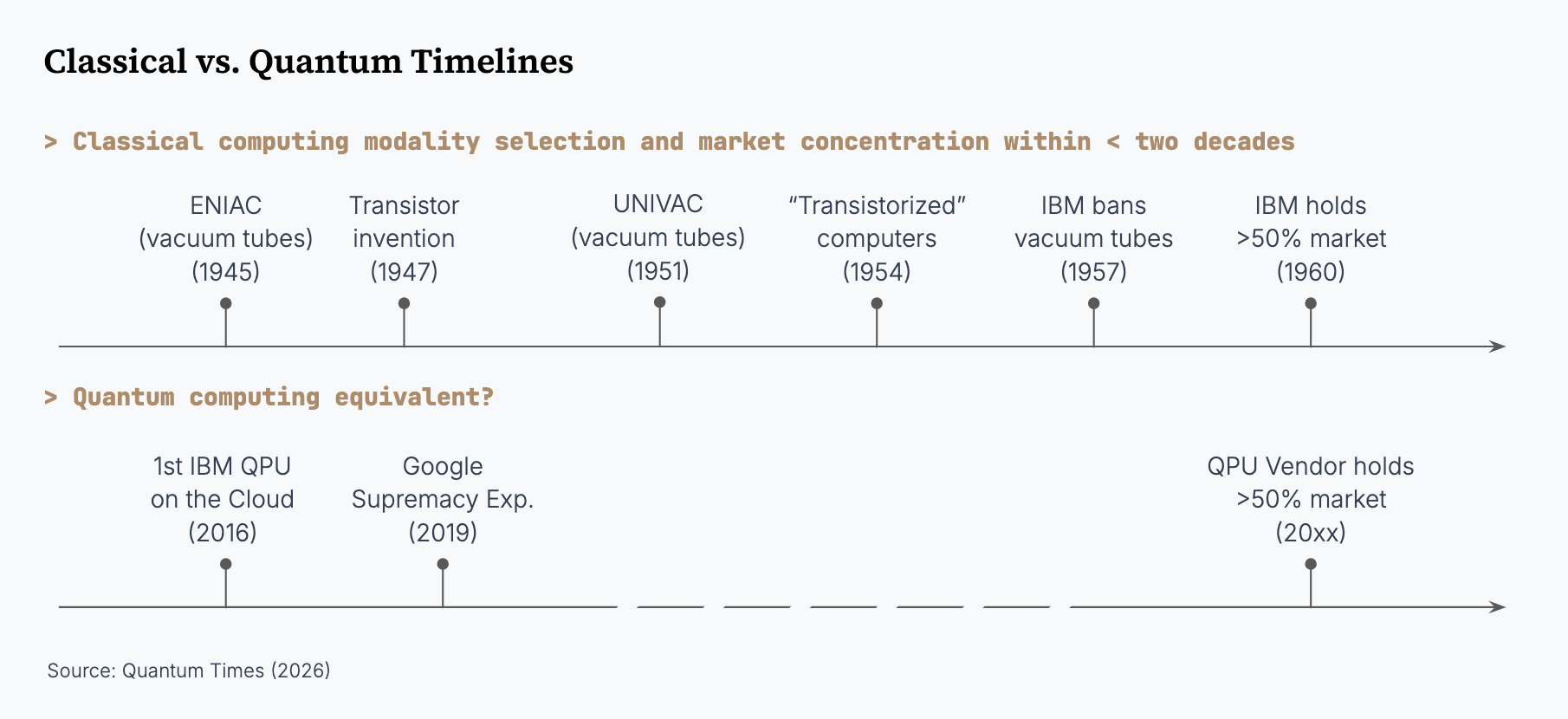
However, if we look at the history of classical computing, things moved quickly. The industry picked both a hardware path and a dominant vendor within less than two decades.
- On the technology side, early machines developed in the 1940s such as the ENIAC relied on vacuum tubes. But the transistor was invented in 1947 at Bell Labs, and by the late 1950s “transistorized” computers were entering the market. More performant15, scalable and cheaper, they rapidly displaced vacuum-tube systems which IBM effectively banned in late 195716. In about ten years, the industry had selected a winning hardware modality.
- Commercially, market concentration was just as fast. In the late 1950s, IBM already held more than 50% of the global computer market.16
So where is quantum today compared with the early days of classical computing: was its “ENIAC moment” Google’s 2019 quantum supremacy result or IBM’s first cloud quantum system in 2016? Could it also be the more recent early demonstrations of quantum advantage for real-world applications?17,18,19
The contexts differ, and historical parallels should be cautiously interpreted. Still, the the question remains: after first proof points over the last 10 years, could the QPU market consolidate into a WTA structure within a couple of decades, as classical computing did?
2. Winner-takes-all forces are already emerging
When several computing technologies offer comparable performance, the market often tips toward the solution backed by the vendor that most effectively builds lock-in – through defensive (e.g. switching costs) or offensive (e.g. economies of scale) mechanisms – rather than toward the technically most performant option. For instance, IBM won the mainframe market though its machines were not technically clearly superior to the UNIVAC, one of their main competitors at the time20,21. Intel and Nvidia established dominant positions in CPUs and GPUs, respectively, while AMD quickly emerged as a strong challenger in both markets with performant products22,23, periodically gaining share but not overturning the overall WTA structure.
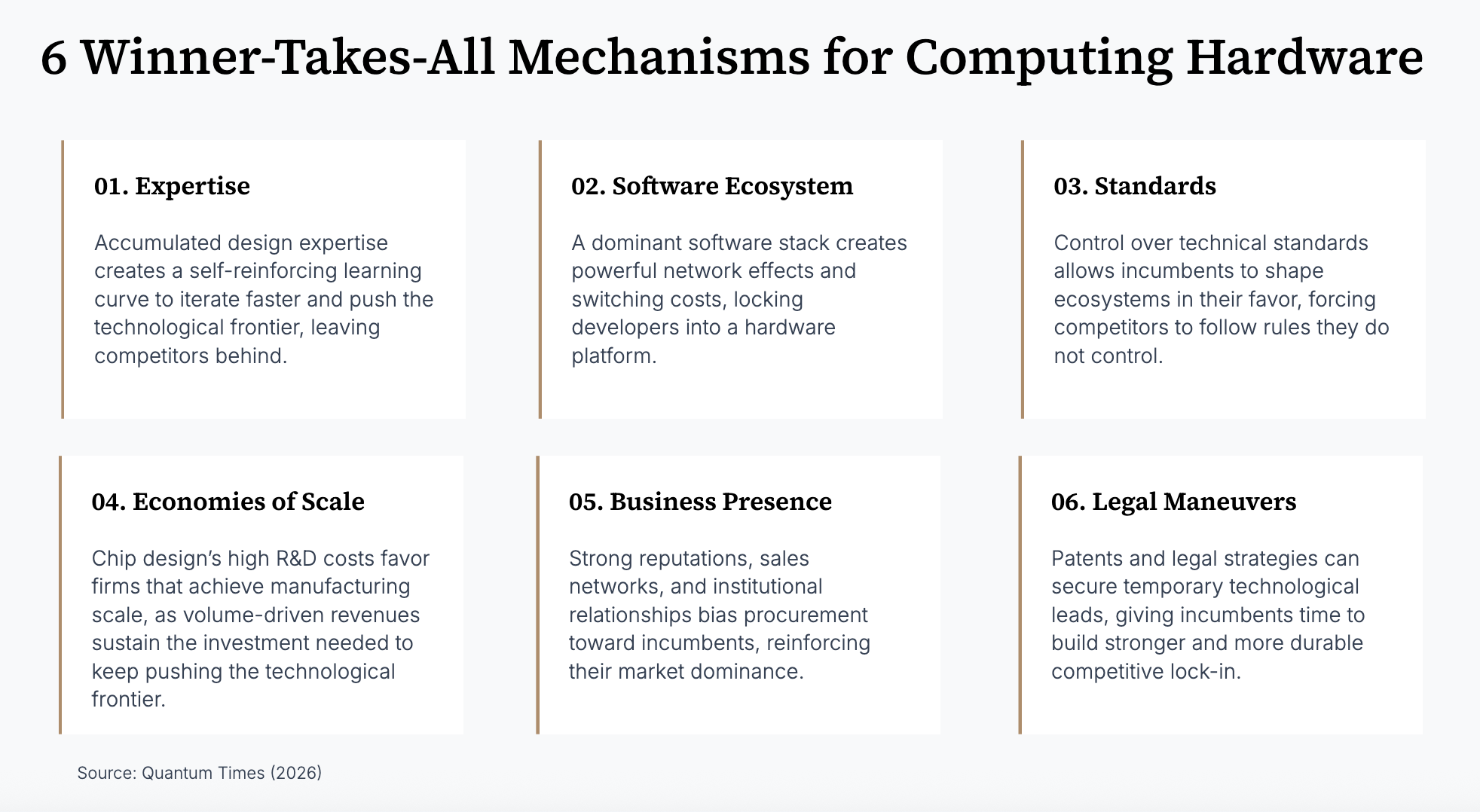
In this section, we compare WTA mechanisms that have been developed in the classical computing field with the strategies emerging in the QPU industry.
1/ Expertise:
- In classical computing, chip design advantage comes from accumulated know-how. Iteration cycles become faster and more informed over time, which has fed Moore’s Law for decades. Once that flywheel starts spinning, new entrants are chasing a moving frontier. In a recent interview, Chris Miller gave the example of the Soviet Union trying to copy US chips during the Cold War: by the time one generation was replicated, the next was already two times more performant24. Emulation and Electronic Design Automation (EDA) reinforced this dynamic: for example, Nvidia developed early expertise in emulation in the 1990s, replacing slow physical iteration with software-driven design to accelerate chip development25,26. But when incumbents fall behind, expertise can also be bought: over the past 20 years, AMD has acquired ATI and Xilinx to strengthen its capabilities in GPU and FPGA design.
- What emerges in quantum computing: EDA capability for quantum chip design was identified as a key competitive advantage by a consortium of researchers that included recent Nobel Prize laureate in Physics John Martinis27 and major players got the message. Amazon Web Services’ quantum program develops Palace, its own electromagnetic simulation software28. In 2024, Nvidia and Google disclosed a partnership that advanced the simulation of Google’s quantum chips with Nvidia GPUs29. As in classical computing, we also notice an acceleration of strategic technology acquisitions over the past year: Google bought MIT spin-off Atlantic Quantum, IonQ purchased Oxford Ionics, and D-Wave integrated QCi. The pattern mirrors classical semiconductors: expertise reduces iteration time, and consolidation becomes a shortcut to close capability gaps.
2/ Software Ecosystem:
- A tightly-coupled and tailored hardware-software environment creates high switching costs for developers who have spent years optimizing code for their specific applications. Relaunching this effort on a new platform might not yield the same performance without significant effort. The canonical example is NVIDIA through CUDA, which played a decisive role in GPU adoption over AMD. Early on, Nvidia cultivated a developer community, creating strong network effects: the more researchers built GPU-accelerated applications, the more attractive the platform became, which in turn drew in even more developers and reinforced its lead. Now, NVIDIA controls the full stack – hardware, middleware, and application libraries – and maintains backward and forward compatibility, ensuring that new GPU generations run existing CUDA code and often deliver performance gains without requiring code rewrites30.
- In quantum computing, similar dynamics are emerging. Several full-stack players (e.g. IBM, Xanadu) are investing heavily to control the programming environment. IBM is currently ahead on this front: around 70% of surveyed quantum developers report using Qiskit, its software platform, typically paired with IBM processors via the cloud31. By structuring and educating a large early user base, IBM could reinforce switching costs: a recent study showed that circuits running on IBM hardware often failed to transpile to IonQ or Quantinuum systems using generic pipelines32. Therefore, at IEEE Quantum Week 2025, Computer Science professors gathered and noted that “the field would benefit from an open-source compiler” because “current industry compilers tend to be only partially open source.”33
3/ Standards:
- In classical computing, control over standards has also generated network-like effects: the more widely a technology is adopted, the more the standards evolve in its favor, reinforcing the leader’s position. For instance, in the 1960s, during the mainframe era, IBM leveraged control over its proprietary standards to maintain dominance over competitors such as Fujitsu, Amdahl, and Hitachi. Indeed, IBM’s ability to change its architecture at will made it increasingly difficult for plug-compatible manufacturers to remain profitable in the long run34. Fast forward to today, even in mature classical computing businesses, control over standards remains highly strategic. In 2024, in the context of growing competition from Arm and RISC-V, Intel and AMD buried the hatchet and partnered to defend the x86 ecosystem35. In 2025, AMD still noted that “Intel is able to drive de facto standards and specifications for x86 microprocessors that could cause [AMD] and other companies to have delayed access to such standards.”36
- In quantum, standards are being defined:
-
- On the software side, they are emerging through usage: as already mentioned, Qiskit is becoming a reference, and more and more hardware providers are building Qiskit-compatible plug-ins to stay relevant37,38,39. Are we already seeing a standard emerge here?
- Regarding QPU benchmarking, no framework has yet emerged as a de facto standard40. But it is strategically important, as benchmark definitions shape how performance is perceived and directly influence procurement decisions.
- On the hardware side, standard definition can shape the supply chain. For example, QPU designers may choose to develop and optimize their own control hardware, decoder or cryogenics to fully own the interface with the QPU and tailor it to their qubit architecture. Alternatively, they can rely on third-party vendors and attempt to influence their roadmap so that it optimizes for their own technology. Some companies have dual approaches: IBM’s quantum program has a tradition of developing the full quantum computing system in-house (not just the QPU) but still partnered with Bluefors on the cryostat on its System Two14 and recently announced a partnership with AMD for the decoding of quantum errors with classical hardware36.
-
4/ Economies of scale:
- Chip design concentrates 65% of the total semiconductor industry R&D investments according to a BCG study4. High R&D costs make scalable manufacturing critical: only by selling enough volumes of chips and generating strong cash flow can firms reinvest in R&D and keep pace with Moore’s law. Even in the early days of classical computing and although UNIVAC was first to market and developed performant systems, IBM scaled manufacturing far more aggressively. To meet demand for the 604 (based on vacuum tubes) in the early 1950s, it implemented the first assembly line for classical computers41. Anticipating transistorized systems, IBM further invested in manufacturing: by 1959, a fully automated transistor production line in Poughkeepsie (US) was operational, producing hundreds of devices per hour16. Scale in classical computing has also often relied on strategic industrial alliances. In the 1960s, IBM finally decided to partner with Texas Instruments to manufacture transistors16. Recently, in the context of Moore’s Second Law (= the cost of a foundry doubles every 4 years), the foundry model led by TSMC enabled fabless chip designers such as Qualcomm, Broadcom, and Nvidia to start and scale their manufacturing with limited investments42.
- At this stage, worldwide QPUs sales – a few dozens of quantum computers per year43 – are likely not sufficient to see significant effects of economies of scale. But partnerships between QPU designers and foundries are already emerging. For instance, PsiQuantum has been working with GlobalFoundries for years44, Quobly with STMicroelectronics45. IBM recently announced that it has transitioned QPU manufacturing from its research lab in Yorktown Heights to the NY CREATES Albany NanoTech Complex, one of the world’s most advanced semiconductor fabrication facilities46. Some other players choose to integrate the fabrication. This year, IonQ acquired SkyWater. In Europe, IQM announced its new fabrication facility capable of producing 30 quantum computers per year47, which is in the order of magnitude of the current annual global market demand for quantum computers43.
5/ Business presence:
- Strong reputations, dense relationship networks, and deep institutional presence reduce perceived risk for buyers and skew procurement decisions toward incumbents. The typical expression of this dynamic is the saying “nobody gets fired for choosing IBM”. Large vendors reinforce this advantage through long-term relationship building, participation in standards bodies (e.g. IEEE), and targeted hiring of decision-makers or leading scientists at key customer accounts. But this strong position needs to be built. For IBM, beyond a reliable technology, it relied on two pillars: a strong sales and marketing machine48, leveraging its already dominant punched card business presence, and smart business model. For example, in the mid-1950s, universities could buy IBM systems at discounts of up to 60% (!) if they offered courses in business data processing or scientific computing21. This move likely helped train a generation of users on IBM machines and contributed to evangelizing the market around its technology.
- In the QPU market, we notice different business strategies. First, we observe specific business models. For instance, IQM offers QPUs “under one million euros” tailored for universities and research labs49, which is reminiscent of IBM’s offer to universities in the 1950s. As a result, IQM alone already represents more than 25% of total worldwide QPU deployments since 202443, which commentators suggest could help support future up-selling as part of a “Razor & Blades” model50. Second, we notice significant investments from some QPU vendors in business development effort. IonQ just reported spending more than 14 million USD quarterly in sales and marketing51, which is equivalent to the annual R&D spending of a European QPU design start-up during Series A. This large funding in sales and marketing indicate a push from QPU vendors to capture significant market shares early in this market.
6/ Legal maneuvers:
- Legal strategies can help chip designers secure a temporary lead during key industry transitions, giving them time to build stronger lock-in mechanisms such as standards and ecosystems. A well-known case is the long dispute between Intel and AMD. In the early 1980s, when IBM selected Intel to supply the processor for its PC, it required Intel to appoint AMD as a second-source supplier, which led the two firms to sign a technology-sharing agreement in 1982. But when Intel released the 386 microprocessor in 1985, it refused to share key technical details with AMD. AMD launched arbitration in 1987, yet the process lasted more than four years, too late to prevent Intel from strengthening its position while the IBM PC compatible market expanded rapidly and its share grew from 55% in 1986 to 84% in 199052. The episode launched one of the most famous legal disputes in the semiconductor industry. Today, intellectual property remains a central part of the chip designers’ strategy. Intel maintains “thousands” of patents related to its leading x86 architecture and its General Counsel Steven Rodgers wrote: “those patents are high-quality, well-prosecuted assets, and no one (other than Intel) has the right to allow others to copy Intel’s technology or to practice all of those patents”53.
- Similar dynamics may emerge in quantum computing. Patent activity in the field has been growing quickly, with the number of quantum computing patent families increasing by about 43% per year between 2015 and 202354. In QPU design specifically, IBM, IonQ, D-Wave Systems and Google are among the most active patent filers, with up to 200 patent families for IBM. Companies frame these portfolios as strategic “moats”51. Indeed, legal analysts note that in several emerging technology waves, foundational patents were often secured before markets really scaled, for example in AI, where many core claims were already filed before mass adoption began55. That said, patent strategies in hardware are risky: they require technical disclosure, which can reveal design choices and does not fully prevent competitors from copying, despite the risk of litigation, if the patents appear weak. In short, legal strategies – including patents but also the choice of not patenting (= trade secrets), tech transfer or defensive publishing – contribute to shaping early competition in the QPU market.
3. What will happen is still unclear
As discussed in the second part, the forces that typically drive winner-takes-all dynamics are already visible in the QPU market. But whether they will ultimately produce a single dominant QPU vendor remains uncertain today.
From a technical perspective, there are reasons to believe the QPU market is WTA-compatible in the long run. BCG estimates that 80% of the long-term economic value of quantum computing will be captured by FTQC systems56. FTQC is built with error correction that creates an exponential relationship between physical resources and system reliability57. Therefore, any QPU technology that simultaneously unlocks “good enough” operation fidelity (what quantum scientists name “below threshold”11) and scalability will gain a Moore’s-law-like advantage, rapidly compounding performance and leaving competitors struggling to catch up (remember Chris Miller’s point on Russia vs. US chip competition during the Cold War). Consequently, performance leadership is likely to concentrate within a single qubit modality for applications that rely on fault-tolerant quantum algorithms, namely chemistry, materials science and cryptanalysis. This convergence of scale and below-threshold operation within one architecture could actually represent the “transistor moment” of quantum computing and potentially enable one vendor to establish durable lock-in (with the aforementioned mechanisms).
However, despite the potential for technical performance to concentrate and the dynamics discussed in the previous section, we identify four reasons why the QPU industry may not evolve into a WTA market:
1/ Additional applications that might not rely on fault-tolerant algorithms could segment the market. Optimization and Machine Learning use cases – with enormous market potential – on noisy (« NISQ ») hardware have yet to show clear value but heuristics and new approaches may emerge as systems scale and users experiment with more capable devices. Alternatively, other types of quantum hardware could also gain relevance, e.g. D-Wave recently reported advantage claims with its annealing QPU58. As a reminder, who could have anticipated in the 1990s that GPUs would largely surpass CPUs for large-scale AI training in the 2010s and that petaflop compute would now fit in a bag for LLM inference?59
2/ QPU market segmentation based on cost / performance tradeoffs is plausible in the near-term. Qubit modalities differ by orders of magnitude in clock speed60, energy consumption14, infrastructure complexity61. If different modalities make it to fault-tolerance, some may be cheaper, or easier to deploy, or faster. Adoption during the next decade may be driven as much by budget and operational constraints as by raw performance.
3/ Potentially less software lock-in: AI coding agents based on large language models could make it easier to modernize legacy code and reduce switching costs for QPU clients. Recently, after Anthropic announced its playbook to migrate from COBOL – the main programming language for mainframes – to modern languages like Java or Python, IBM’s stock fell sharply62. Though COBOL codes are complex and performance-critical (in use by major banks and government systems), and large-scale AI-driven replacement is still unproven63, the market reaction suggests this trend could also matter for future QPU market dynamics.
4/ Customer behavior, especially governments, may shape the outcome as much as technology. Quantum computing is treated as strategic infrastructure. Public actors may be reluctant to depend on a single QPU vendor or even a single hardware modality, given supply chain vulnerabilities and geopolitical risks. As a result, they may continue funding multiple approaches in parallel and/or control exports creating multi-domestic markets.
Down the road, if QPUs expand through performance improvement or miniaturization into broader – potentially consumer – markets, leadership may not transfer across technological cycles. While analogies with classical computing should be treated cautiously, history shows that IBM led mainframes but failed in CPUs and Intel led CPUs but not GPUs. Future technology transitions for QPU could therefore reshuffle the competitive landscape: the winner of the 2030s may not be the winner of the 2040s.
Conclusion
WTA dynamics are beginning to appear in the QPU market and increasingly follow the classical computing playbook: deep in-house expertise to sustain performance scaling, network effects through software ecosystems and standards, industrial and business model readiness aimed at capturing future larger market share and patent strategy aiming at defending it.
Yet the outcome remains uncertain. There are credible arguments for both concentration and segmentation. One thing is certain though, “the game is on again” with quantum computing, as the ABBA song puts it. And it’s fun to watch!

Victor Kerros is Chief of Staff at Alice&Bob USA. Previously he was a Data Scientist in the MedTech industry.
References
1P. Barwise, “Nine reasons why tech markets are winner-take-all”, Jul. 2018, (https://www.london.edu/think/nine-reasons-why-tech-markets-are-winner-take-all) [Accessed: Mar. 2, 2026].
2Mordor Intelligence, “Mainframe Market Size & Share Analysis – Growth Trends and Forecast (2026 – 2031)”, Jan. 2026, (https://www.mordorintelligence.com/industry-reports/mainframe-market) [Accessed: Mar. 2, 2026].
3Open Mainframe Project, “Mainframe: The Next 60 Years,” Apr. 2024, (https://openmainframeproject.org/wp-content/uploads/sites/14/2024/04/mainframe_next_60_years_041024a.pdf) [Accessed: Mar. 2, 2026].
4Boston Consulting Group and Semiconductor Industry Association, “Strengthening the Global Semiconductor Value Chain in an Uncertain Era,” Apr. 2021. (https://www.semiconductors.org/wp-content/uploads/2021/05/BCG-x-SIA-Strengthening-the-Global-Semiconductor-Value-Chain-April-2021_1.pdf) [Accessed: Mar. 2, 2026].
5M. A. Cusumano, “Intel’s Fall from Grace,” Commun. ACM, vol. 68, no. 1, pp. 30–32, Jan. 2025, doi: [10.1145/3704288](https://doi.org/10.1145/3704288).
6B. Ferreira, “IBM stock takes a 13 percent whiplash after Anthropic announces an AI tool for writing COBOL code,” Tom’s Hardware, Feb. 2026, (https://www.tomshardware.com/tech-industry/big-tech/ibm-stock-takes-a-13-percent-whiplash-after-anthropic-announces-an-ai-tool-for-writing-cobol-code-stock-has-worst-day-since-2000-and-is-down-25-percent-mom-and-counting) [Accessed: Mar. 2, 2026].
7T. Mickle, “Nvidia Hits $4 Trillion Market Value,” The New York Times, Jul. 2025, (https://www.nytimes.com/2025/07/10/technology/nvidia-4-trillion-market-value.html) [Accessed: Mar. 2, 2026].
8IDC, “Semiconductor Market Outlook,” Sep. 2025, (https://www.semi.org/sites/semi.org/files/2025-09/1%20%EA%B9%80%EC%88%98%EA%B2%B8_IDC%20Semiconductor%20Market%20Outlook.pdf) [Accessed: Mar. 2, 2026].
9J.-F. Bobier, “How Error Correction Impacts Value Creation and What’s Next?,” Jul. 2024, (https://www.youtube.com/watch?v=5DmyTkse6-Y) [Accessed: Mar. 2, 2026].
10NVIDIA, “COMPUTEX 2025: Jensen Huang Keynote,” NVIDIA Blog, 2025, (https://blogs.nvidia.com/blog/computex-2025-jensen-huang/) [Accessed: Mar. 2, 2026].
11Google Research, “Making quantum error correction work,” Google Research Blog, (https://research.google/blog/making-quantum-error-correction-work/) [Accessed: Mar. 2, 2026].
12QuEra Computing, “Harvard, QuEra, MIT and the NIST/University of Maryland usher in new era of quantum computing by performing complex error-corrected quantum algorithms on 48 logical qubits,” QuEra Press Release, Dec. 2023, (https://www.quera.com/press-releases/harvard-quera-mit-and-the-nist-university-of-maryland-usher-in-new-era-of-quantum-computing-by-performing-complex-error-corrected-quantum-algorithms-on-48-logical-qubits) [Accessed: Mar. 2, 2026].
13Quantinuum, “A new breakthrough in logical quantum computing reveals the scale of our industry leadership,” Quantinuum Blog, Apr. 2024, (https://www.quantinuum.com/blog/a-new-breakthrough-in-logical-quantum-computing-reveals-the-scale-of-our-industry-leadership) [Accessed: Mar. 2, 2026].
14O. Ezratty, “Understanding Quantum Technologies 2025,” Oct. 2025, doi: 10.48550/arXiv.2111.15352.
15IBM, “7090 Data Processing System », Sept. 1959, (https://archive.computerhistory.org/resources/text/IBM/Stretch/pdfs/03-01/102633929.pdf) [Accessed: Mar. 2, 2026].
16R. Garner, “Early Popular Computers, 1950–1970,” Engineering and Technology History Wiki, Jan. 2015, (https://ethw.org/Early_Popular_Computers,_1950_-_1970) [Accessed: Mar. 2, 2026].
17Quantinuum, “Simulating magnetism at the classical limits with a digital quantum computer,” Quantinuum Webinar, May 2025, (https://www.quantinuum.com/webinar/simulating-magnetism-at-the-classical-limits-with-a-digital-quantum-computer) [Accessed: Mar. 2, 2026].
18D-Wave Quantum Inc., “Beyond classical: D-Wave first to demonstrate quantum supremacy on useful real-world problem,” D-Wave Press Release, Mar. 2025, (https://www.dwavequantum.com/company/newsroom/press-release/beyond-classical-d-wave-first-to-demonstrate-quantum-supremacy-on-useful-real-world-problem/) [Accessed: Mar. 2, 2026].
19Google, “Quantum echoes: Willow and verifiable quantum advantage,” Google Blog, Oct. 2025, (https://blog.google/innovation-and-ai/technology/research/quantum-echoes-willow-verifiable-quantum-advantage/) [Accessed: Mar. 2, 2026].
20J. Greenwald, “The Colossus That Works,” Time, Jul. 1983, (https://time.com/archive/6882815/the-colossus-that-works/) [Accessed: Mar. 2, 2026].
21P. E. Ceruzzi, A history of modern computing, 2nd ed. London, Eng. ; Cambridge, Mass: MIT Press, 2003.
22J. Roach, “AMD vs Intel CPUs,” Tom’s Hardware, Dec. 2025, (https://www.tomshardware.com/features/amd-vs-intel-cpus) [Accessed: Mar. 2, 2026].
23SemiAnalysis, “AMD vs Nvidia inference benchmark: Who wins performance cost per million tokens?,” SemiAnalysis Newsletter, Mar. 2025, (https://newsletter.semianalysis.com/p/amd-vs-nvidia-inference-benchmark-who-wins-performance-cost-per-million-tokens) [Accessed: Mar. 2, 2026].
24HC Group, “Chip War: How Semiconductors Became the New Oil with Chris Miller,” Sep. 2023, (https://www.hcgroup.global/insights/hc-insider-podcast/chip-war-how-semiconductors-became-the-new-oil-with-chris-miller) [Accessed: Mar. 2, 2026].
25Acquired, “Nvidia Part I: The GPU Company (1993-2006)”, Mar. 2022, (https://www.acquired.fm/episodes/nvidia-the-gpu-company-1993-2006) [Accessed: Mar. 2, 2026].
26Blunty, “Emulating Nvidia GPUs ,” Apr. 2016, (https://www.youtube.com/watch?v=650yVg9smfI) [Accessed: Mar. 2, 2026].
27M. Mohseni et al., “How to Build a Quantum Supercomputer: Scaling from Hundreds to Millions of Qubits,” Jan. 31, 2025, doi: 10.48550/arXiv.2411.10406.
28Amazon Web Services, “AWS releases open-source software PALACE for cloud-based electromagnetics simulations of quantum computing hardware,” AWS Quantum Technologies Blog, Feb. 2023, (https://aws.amazon.com/blogs/quantum-computing/aws-releases-open-source-software-palace-for-cloud-based-electromagnetics-simulations-of-quantum-computing-hardware/) [Accessed: Mar. 2, 2026].
29NVIDIA, “NVIDIA accelerates Google Quantum AI processor design with simulation of quantum device physics,” NVIDIA Press Release, Nov. 2024, (https://investor.nvidia.com/news/press-release-details/2024/NVIDIA-Accelerates-Google-Quantum-AI-Processor-Design-With-Simulation-of-Quantum-Device-Physics/default.aspx) [Accessed: Mar. 2, 2026].
30F. Tabor, “Tech Giants’ Ecosystem Strategies”, Aug. 2025, (https://www.francescatabor.com/articles/2025/8/17/tech-giants-ecosystem-strategies) [Accessed: Mar. 2, 2026].
31Unitary Foundation, “Unitary Foundation Survey 2025,” 2025, (https://unitaryfoundation.github.io/survey-2025/) [Accessed: Mar. 2, 2026].
32P. Bagourd, J. Jang-Jaccard, V. Lenders, A. Mermoud, T. Hoefler, and C. Hempel, “Practical Challenges in Executing Shor’s Algorithm on Existing Quantum Platforms,” Jan. 13, 2026, doi: 10.48550/arXiv.2512.15330.
33J. Palsberg et al., “Computer Science Challenges in Quantum Computing: Early Fault-Tolerance and Beyond,” Jan. 28, 2026, doi: 10.48550/arXiv.2601.20247.
34K. Flamm, “The Computer Industry in Industrialized Economies: Lessons for the Newly Industrializing”, Mar. 1989, (https://documents1.worldbank.org/curated/en/441811468739307238/pdf/multi0page.pdf) [Accessed: Mar. 2, 2026].
35T. Prickett Morgan, « Intel And AMD Make X Less Of A Variable For X86 Processors », Oct. 2024, The Next Platform, (https://www.nextplatform.com/compute/2024/10/16/intel-and-amd-make-x-less-of-a-variable-for-x86-processors/1658383) [Accessed: Mar. 2, 2026].
36Advanced Micro Devices, Inc., “IBM and AMD join forces to build the future of open, secure and scalable AI infrastructure,” AMD Press Release, Aug. 26, 2025, (https://www.amd.com/en/newsroom/press-releases/2025-8-26-ibm-and-amd-join-forces-to-build-the-future-o.html) [Accessed: Mar. 2, 2026].
37IonQ, “IonQ Qiskit SDK documentation,” IonQ Docs, (https://docs.ionq.com/sdks/qiskit) [Accessed: Mar. 2, 2026].
38Quantinuum, “Using Qiskit with Quantinuum Devices,” Quantinuum Documentation, (https://docs.quantinuum.com/systems/trainings/alternate_pathways/qiskit_h2.html) [Accessed: Mar. 2, 2026].
39QuEra Computing, “What is Qiskit?,” QuEra Glossary, (https://www.quera.com/glossary/qiskit) [Accessed: Mar. 2, 2026].
40T. Proctor, K. Young, A. D. Baczewski, and R. Blume-Kohout, “Benchmarking quantum computers,” Nat Rev Phys, vol. 7, no. 2, pp. 105–118, Jan. 2025, doi: 10.1038/s42254-024-00796-z.
41J. Strickland, “How Did IBM Get Into the Computer Business So Quickly?”, Jul. 2011, (https://www.ed-thelen.org/comp-hist/IBM-vs-7Dwarfs.html) [Accessed: Mar. 2, 2026].
42Acquired, “TSMC,” Sept. 2021, (https://www.acquired.fm/episodes/tsmc) [Accessed: Mar. 2, 2026].
43N. Abroug, “Global Quantum Computing Hardware Dataset”, Feb. 10 2026, (https://gitlab.inria.fr/nabroug/qpus-worldwide-global-quantum-computing-hardware-dataset) [Accessed: Mar. 2, 2026].
44GlobalFoundries, “PsiQuantum and GlobalFoundries build world’s first full-scale quantum computer,” GlobalFoundries Press Release, 2021, (https://gf.com/dresden-press-release/psiquantum-and-globalfoundries-build-worlds-first-full-scale-quantum-computer/) [Accessed: Mar. 2, 2026].
45STMicroelectronics, “Quobly Forges Strategic Collaboration with STMicroelectronics to Accelerate its Quantum Processor Manufacturing for Large-Scale Quantum Computing Solutions,” STMicroelectronics Press Release, Dec. 2024, (https://newsroom.st.com/media-center/press-item.html/t4667.html) [Accessed: Mar. 2, 2026].
46R. Thomas, “Lost in translation: What the AI code debate keeps getting wrong,” IBM Newsroom, Feb. 2026, (https://newsroom.ibm.com/blog-lost-in-translation-what-the-ai-code-debate-keeps-getting-wrong) [Accessed: Mar. 2, 2026].
47IQM Quantum Computers, “IQM to invest over €40 million to expand Finland production facility, accelerate innovation and fuel growth,” IQM Press Release, Nov. 2025, (https://meetiqm.com/press-releases/iqm-to-invest-over-e40-million-to-expand-finland-production-facility-accelerate-innovation-and-fuel-growth/) [Accessed: Mar. 2, 2026].
48J. Greenwald, “The Colossus That Works,” Time, Jul. 1983, (https://time.com/archive/6882815/the-colossus-that-works/) [Accessed: Mar. 2, 2026].
49IQM, « Democratising access to quantum computing: IQM Quantum Computers launches “IQM Spark” for universities and labs », IQM Press Release, Aug. 2023, (https://meetiqm.com/press-releases/democratising-access-to-quantum-computing-iqm-quantum-computers-launches-iqm-spark-for-universities-and-labs/) [Accessed: Mar. 2, 2026].
50D. Siegelwax, “IQM’s Razor Blades & Dragon,” The Modern Scientist (Medium), Jun. 2025, (https://medium.com/the-modern-scientist/iqms-razor-blades-dragon-10d85b62c052) [Accessed: Mar. 2, 2026].
51IonQ, Inc., “IonQ Announces Third Quarter 2025 Financial Results,” IonQ Press Release, Nov. 2025, (https://investors.ionq.com/news/news-details/2025/IonQ-Announces-Third-Quarter-2025-Financial-Results/default.aspx) [Accessed: Mar. 2, 2026].
52Greg Tang, “Intel and the x86 Architecture: A Legal Perspective,” Harvard Journal of Law & Technology Digest, Jan. 2011, (https://jolt.law.harvard.edu/digest/intel-and-the-x86-architecture-a-legal-perspective) [Accessed: Mar. 2, 2026].
53Steven Rodgers, “The Importance of Intel’s x86 Intellectual Property,” Intel Policy Blog, Feb. 2017, (https://community.intel.com/t5/Blogs/Intel/Policy-Intel/The-Importance-of-Intel-s-x86-Intellectual-Property/post/1332956) [Accessed: Mar. 2, 2026].
54A Portrait of the Global Patent Landscape in Quantum Technologies, EuroQuIC Report, Feb. 2026, (https://www.euroquic.org/wp-content/uploads/2026/02/A-Portrait-of-the-Global-Patent-Landscape-in-Quantum-Technologies.pdf) [Accessed: Mar. 2, 2026].
55Kamyar Maserrat and R. Whitney Johnson, “Pivotal Push from Lab to Leverage: Why Now Is the Window to Secure Foundational Quantum Patents,” Foley & Lardner, Oct. 2025, (https://www.foley.com/insights/publications/2025/10/pivotal-push-from-lab-to-leverage-why-now-is-the-window-to-secure-foundational-quantum-patents/) [Accessed: Mar. 2, 2026].
56Boston Consulting Group, “The long-term forecast for quantum computing still looks bright,” BCG, Jul. 2024, (https://www.bcg.com/publications/2024/long-term-forecast-for-quantum-computing-still-looks-bright) [Accessed: Mar. 2, 2026].
57C. Gidney, « Quantum Error Correction goes FOOM », Dec. 2025, (https://algassert.com/post/2503) [Accessed: Mar. 2, 2026].
58D-Wave Quantum Inc., “Beyond classical: D-Wave first to demonstrate quantum supremacy on useful real-world problem,” D-Wave Press Release, Mar. 2025, (https://www.dwavequantum.com/company/newsroom/press-release/beyond-classical-d-wave-first-to-demonstrate-quantum-supremacy-on-useful-real-world-problem/) [Accessed: Mar. 2, 2026].
59NVIDIA, “NVIDIA puts Grace Blackwell on every desk and at every AI developer’s fingertips,” NVIDIA Newsroom, Jan. 2025, (https://nvidianews.nvidia.com/news/nvidia-puts-grace-blackwell-on-every-desk-and-at-every-ai-developers-fingertips) [Accessed: Mar. 2, 2026].
60D. Camps et al., “Quantum Computing Technology Roadmaps and Capability Assessment for Scientific Computing — An analysis of use cases from the NERSC workload,” Sept. 2025, doi: 10.48550/arXiv.2509.09882.
61M. Gould and K. Prebble, “An Economic Analysis of Quantum Computing”, Apr. 2025, (https://docsend.com/view/iyxs3jkteiukwreu) [Accessed: Mar. 2, 2026].
62J. Roach, “AMD vs Intel CPUs,” Tom’s Hardware, Dec. 2025, (https://www.tomshardware.com/features/amd-vs-intel-cpus) [Accessed: Mar. 2, 2026].
63R. Thomas, “Lost in translation: What the AI code debate keeps getting wrong,” IBM Newsroom, Feb. 2026, (https://newsroom.ibm.com/blog-lost-in-translation-what-the-ai-code-debate-keeps-getting-wrong) [Accessed: Mar. 2, 2026].